The Digital Status Crisis
The Digital Status Crisis report exposes critical failures of the UK’s eVisa system, the mandatory digital status that approximately ten million people rely on to prove their right to work, rent, travel and access public services.
the3million has been collecting evidence and analysing systemic issues within this system since 2020. EU citizens and family members were the first to receive an immigration status which could only be proved through online access, now known as an eVisa. This digital-only system has been extended to all migrants in the UK, and our research examines systemic failures experienced people on all immigration routes.
Drawing on evidence from eVisa holders, the report challenges Home Office claims about the system’s security and reliability, revealing a Digital Status Crisis: a systemic failure in which people with lawful rights cannot reliably prove those rights, echoing the injustices of the Windrush Scandal.
The evidence base
The report draws on evidence from 1,877 reports of digital status problems collected through our Report It! forms, directly by those affected.
To date, the government has refused to disclose the scale of error reports submitted directly to the Home Office, despite numerous Freedom of Information requests and Parliamentary questions.
Our own data has significant limitations:
- Forms are self-selecting - people need to know about the3million, be aware of our reporting platforms and be willing to share their data.
- Forms are unlikely to capture the experiences of the most vulnerable.
- Forms are digital - so digitally excluded people are under-represented in our data.
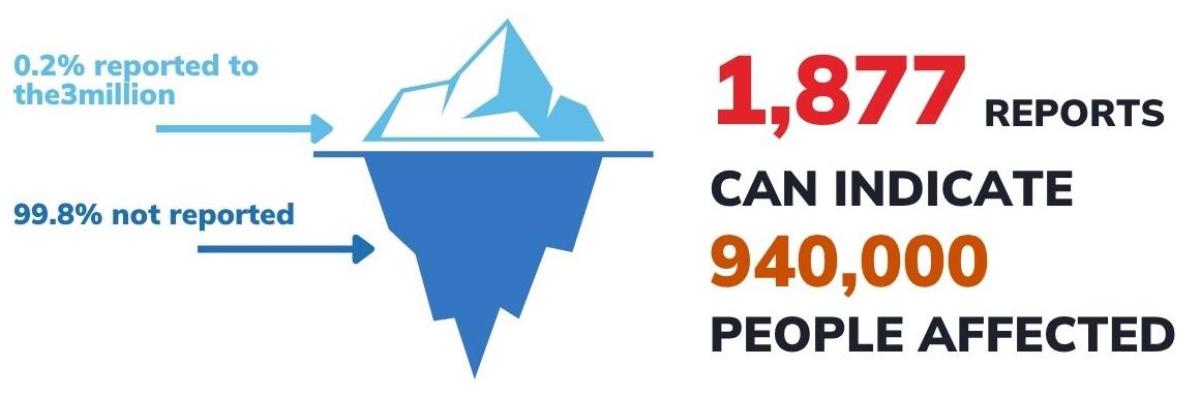
Given these limitations, we are aware we can only capture the tip of the iceberg of problems with eVisas.
To estimate the true scale of issues, we have analysed the only two major incidents where the Home Office has disclosed data on the number of errors. We compare their figures with the number of reports we received on each of these incidents, to make an informed guess at the percentage of problems that actually result in a report to the3million.
From this available data, we can make a conservative estimate that less than 0.2% of actual problems are reported to the3million. If 1,877 reports to the3million represents 0.2% of the actual number of problems experienced by people, this translates to nearly 940,000 people who could be impacted by eVisa issues struggling to prove their rights in the UK.
Types of eVisa problems
Failures of the eVisa system seriously impact people’s ability to live, work, study, access services, and travel. Problems include:
1. Errors in eVisa information and linking ID documents:
Common issues include:
- Incorrect information shown on eVisas (personal details, visa details, and the rights associated with the visa)
- Inability to link new ID documents (essential for travel), due to:
- Technical failures in the linking functionality
- The system wrongly rejecting updates, for example, mistakenly claiming that the person has changed their name
2. Can’t use eVisa as proof
Even when the UKVI account and eVisa are set up correctly, problems persist:
- Third-party checkers (employers, landlords, airlines, banks) often refuse to accept eVisas as valid proof, due to unfamiliarity with digital visa systems
- People cannot prove their status on demand because:
- They don’t have internet access
- They don’t have smartphones
- They face digital literacy challenges
3. Inability to access eVisa
Due to errors in the Home Office eVisa systems, many people are unable to:
- Create a UKVI account, or link it to their eVisa
- Access their immigration status through View & Prove
- Generate a share code to prove their status to others
4. Lack of support when things go wrong
When people encounter issues, help is often unavailable or inadequate:
- They are referred to automated webchats that rarely connect them to human operators
- The 24/7 travel helpline was shut down a few months after launch
- Automated responses cite significant delays due to “high enquiry volumes”
- The Home Office refuses to disclose the volume of errors despite Freedom of Information requests and Parliamentary Questions.
Debunking common eVisa myths
The report debunks several myths perpetuated by the Home Office about the eVisa system, namely that:
- Myth 1: eVisas cannot be lost, stolen or tampered with
- Myth 2: The introduction of digital ID will tackle irregular working.
- Myth 3: There is support from the Home Office when something goes wrong with your eVisa.
- Myth 4: Digital IDs allow for more efficient use of public services
- Myth 5: Adopting more digital tools will help the Home Office prevent another Windrush-like scandal.
Successive governments’ claims that greater digitalisation improves immigration compliance fail scrutiny.
Recommendations
This report calls for immediate action to rectify the current digital status crisis. We are seeing similar patterns that led to the stripping of the citizenship rights of tens of thousands people in the Windrush Scandal. People who have rights but do not have a stable and reliable way to prove those rights.
To address the issues with the eVisa system, the government must:
1. Immediately and substantially increase resources to fix the foundations of the current eVisa data held by the Home Office on ten million people, before this data forms the basis of a new mandatory digital ID system. This includes:
- helplines that allow eVisa holders to speak directly with Home Office staff who can fix their problems on the spot, or otherwise within hours, rather than webchats or error forms that leave people in limbo for weeks or sometimes months.
- far greater efforts to proactively address technical problems and eVisa data inaccuracy.
- vastly improved development processes to avoid repeats of computer bugs, and insufficient testing of fixes for those bugs, that affect thousands of statuses.
2. Provide proof of digital immigration status that is inclusive and reliable:
- any form of digital status must be stable, reliable and secure.
- it must be possible to prove status even when not connected to the internet.
- it should be possible to print it as a backup, just like a boarding pass that can be scanned.
- the Government must provide it in card form to those who need it and are digitally excluded.
3. Conduct a full independent review into the eVisa system and increase transparency on the volume and range of errors reported to the Home Office.
4. Demonstrate that the lessons of the critical failures of the eVisa system have been learned before mandatory digital ID is further rolled out.
- The Government must conduct meaningful engagement with relevant stakeholders, such as the people who are using and are impacted by the eVisa system.