
Summary of changes to the EU Settlement Scheme since 2018
Since the EU Settlement Scheme (EUSS) opened in March 2019 (after some small scale trials from August 2018), the scheme rules have undergone significant changes.
Some of these changes were as a result of advocacy by stakeholders, others as a result of court judgments. Some of the changes affect only a relatively small number of people, but some changes were fundamental to the EUSS.
This page sets out the timeline of the most significant changes that affect everyone across the board, and tries to explain the rationale behind some of the changes.
LATEST UPDATE JULY 2025
- August 2018 - EUSS pilot phase
The EUSS opens as a pilot phase, by invitation only. It costs £65 to make an application (and £32.50 for children under 16). The pilot phases included Private Beta 1 (27 August - 17 October 2018), Private Beta 2 (1 November - 21 December 2018), and Public Beta (21 January - 29 March 2019).
In order to be eligible for settled status, people need to show they were resident in the UK for five years. Shorter length of residence results in pre-settled status.
Non-EU family members need to provide other evidence related to their family relationship.
Anyone who receives a refusal is able to appeal the decision to the First Tier Tribunal, or apply for an Administrative Review (AR).
- An AR costs £80. A different Home Office caseworker looks again at the application, and it is possible to add more evidence at this stage. If the refusal is overturned, the £80 fee is refunded unless it was only overturned because of the new evidence added.
- An appeal costs more, and would usually involve legal advice.
- January 2019 - EUSS fee dropped
The Prime Minister Theresa May announces that the EUSS will now be free to apply to. She mentions having listened to organisations like the3million. Any fees already paid during the pilot phase will be reimbursed.
- March 2019 - EUSS opens
The EUSS opens to all EU/EEA and Swiss citizens who were living in the UK on or before 31 December 2020, and their eligible family members.
- 31 December 2020 - End of Transition Period
While the UK left the EU on 31 January 2020, EU free movement law continued to operate in the UK until 31 December 2020, during what was known as the transition period.
Eligible family members could still arrive in the UK from 1 January 2021 onwards and make an application to the EUSS, if their sponsor was an EU/EEA/Swiss citizen with EUSS status who had been living in the UK on or before 31 December 2020.
- 30 June 2021 - End of Grace Period
30 June 2021 was the deadline to apply to the EUSS for those who were living in the UK on or before 31 December 2020. For joining family members, the deadline to apply was 3 months after their arrival (or birth) in the UK.
After the deadline, the Home Office gave the benefit of the doubt to all late applicants, accepting their applications to the EUSS and considering them for eligibility, without looking at whether there were reasonable grounds for having missed the application deadline.
However, the Home Office insisted that those who missed the 30 June 2021 EUSS deadline would be unlawfully resident in the UK until they were granted status, including during the period after making a late application and while waiting for a decision to be made. The3million argued this was a breach of the Withdrawal Agreement, as Article 18(3) makes clear that having submitted a valid application, the applicant must be deemed to have all Withdrawal Agreement rights until a final decision (including for example during an appeal process) is made.
- 6 August 2021 - Late applicants have rights protected pending a decision
The Home Office announces a U-turn and says that those who missed the deadline will have their residence rights protected while waiting for their decision on their EUSS application.
- 21 December 2022 - Judgment in IMA Judicial Review
The High Court issues their judgment in a case against the Home Office, brought by the Independent Monitoring Authority (IMA). the3million and the European Commission intervened in the case.
The judgment says that a pre-settled status holder, who continues to meet the conditions of the Withdrawal Agreement, cannot lose their status by that status expiring, even if they have not submitted a further EUSS application for settled status or to extend their pre-settled status. The judgment also says that a pre-settled status holder, who has accrued five years of continuous residence, meeting the conditions of the Withdrawal Agreement, automatically acquires permanent residence rights even if they have not applied for, or been granted, settled status.
The Home Office asks for permission to appeal the judgment.
In February 2023, the Home Office announces that they will not appeal the judgment, and will start making changes to the EU Settlement Scheme to implement the judgment. Changes must be made to the EUSS before September 2023, because that is when the earliest grants of pre-settled status (from September 2018) would expire.
- 9 August 2023 - Surinder Singh and Zambrano EUSS routes closed
As announced on 17 July 2023, no new applications to the EU Settlement Scheme under the ‘Surinder Singh’ and ‘Zambrano’ routes can be made after 8 August 2023.
- 9 August 2023 - Reasonable grounds check for late applications made a validity requirement
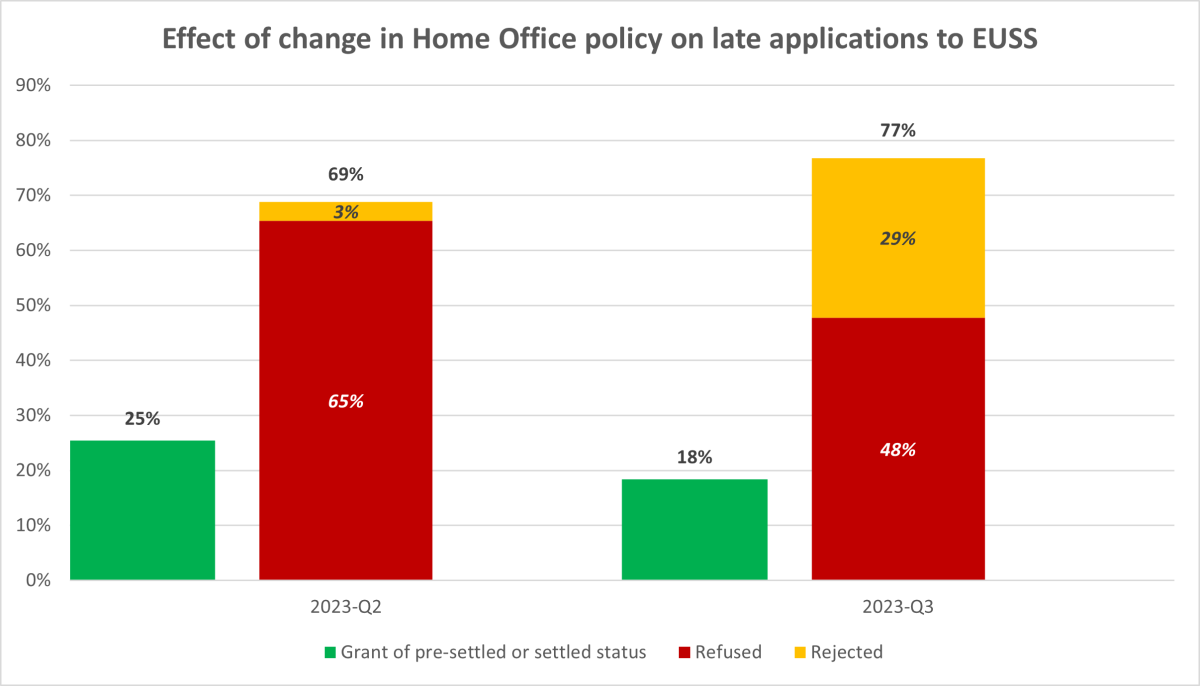
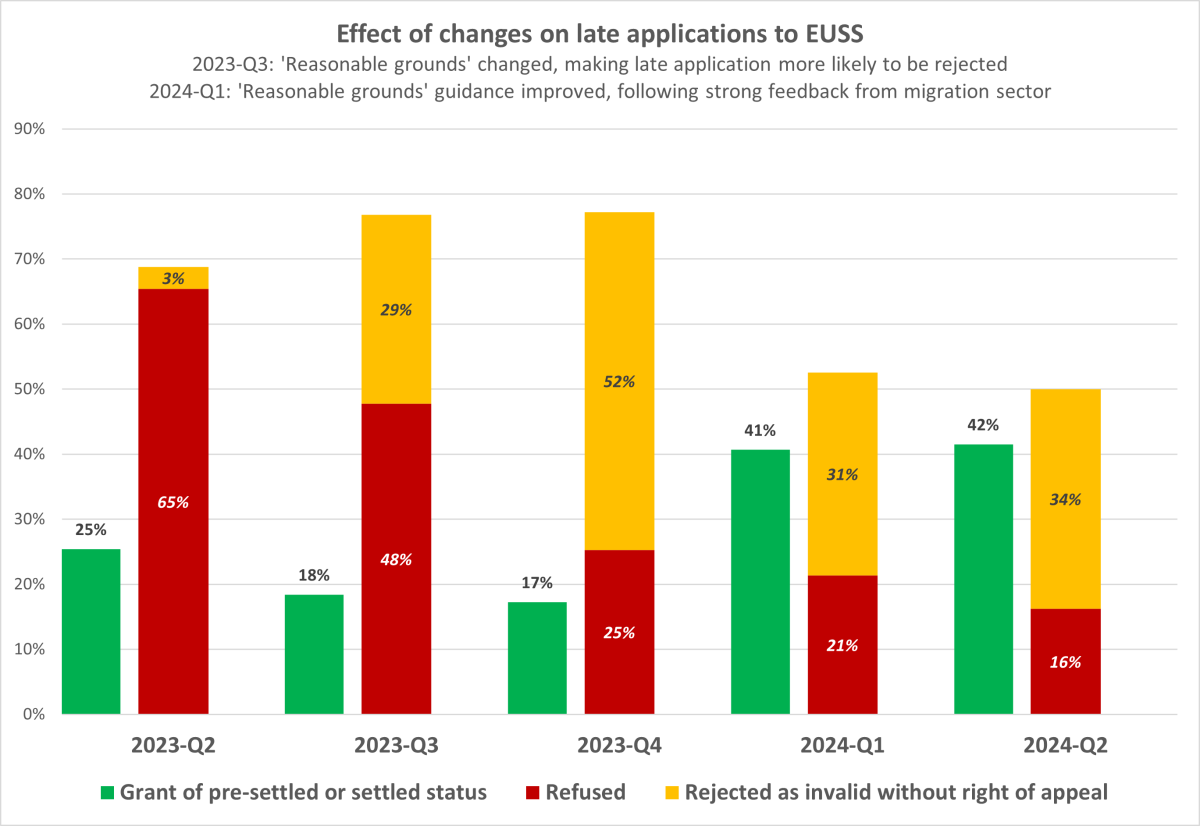
As announced on 17 July 2023, any applications for status under the EU Settlement Scheme that are made after the relevant deadline can be rejected as invalid if the Home Office is not satisfied that there are reasonable grounds for making a late application.
The deadline was 30 June 2021 for those living in the UK on or before 31 December 2020, and three months after arrival (or birth) in the UK for joining family members.
When an application is rejected as invalid, no Certificate of Application is issued, and there is no right of appeal or right to Administrative Review.
The caseworker guidance was very restrictive on what could be accepted as a reasonable ground, so we started seeing many rejections including for people who for example already had a Permanent Residence document or an EEA Biometric Residence Card from the Home Office, who had not realised they needed to make an application to the EUSS.
the3million, ILPA and 55 other organisations wrote to the Home Office objecting to the changes.
- September 2023 - 2 year pre-settled status extensions start
The Home Office announced in July 2023 that, from September 2023, people with pre-settled status will automatically have their status extended by 2 years shortly before it expires. This is to ensure compliance with the IMA judgment, however, the extensions are applied to all pre-settled status holders approaching their expiry date, regardless of eligibility. Therefore there will be people who obtained pre-settled status and have since permanently left the UK, who will also have received this extension.
- 5 October 2023 - Removal of Administrative Review
As announced on 7 September 2023, it is no longer possible to request an Administrative Review of any decisions to refuse an application for status under the EUSS, or for an EUSS Family Permit, where the decision was made on or after 5 October 2023.
- 16 January 2024 - New caseworker guidance on ‘reasonable grounds’ for late applications
Following the changes to late applications on 9 August 2023, and representations from stakeholders, the EUSS caseworker guidance is changed to ensure more eligible late applicants to the EUSS are able to submit late applications. In the Home Office reply to a letter from the3million and ILPA, they write:
“The guidance already permits the taking into consideration of compelling factors as part of that assessment, but, as with all aspects of the rules and guidance for the EUSS, we have kept the approach to reasonable grounds under review since 9 August and have taken account of feedback from stakeholders through the EUSS user groups and otherwise. As you know, the EUSS caseworker guidance is regularly updated and this process is currently under way in respect of the changes to Appendix EU in Statement of Changes HC 246, laid on 7 December 2023, which have effect from 16 January 2024. The same update to the guidance will also make changes relevant to this correspondence in the light of operational experience and feedback from stakeholders. In particular, it will deal with circumstances in which a person may have had a reasonable belief they did not need to apply earlier to the EUSS, or a reasonable basis for being unaware they needed to apply.”
- 21 May 2024 - Pre-settled status deemed to have lapsed after 5 years’ absence
The ‘Immigration (Leave to Enter and Remain) Order 2000’ (LTERO) was changed, so that pre-settled status holders can be absent for 5 years (or four years for Swiss citizens and their family members) before their status lapses. This previously was deemed to have lapsed after 2 years.
The change is not retrospective, so the pre-settled status of anyone who had already had a continuous absence for 2 years before 21 May 2024 would already have been deemed to have lapsed.
- 13 June 2024 - Pre-settled status expiry date hidden from checkers
Following an announcement in May 2024, third parties (such as employers, landlords or others) no longer see an expiry date when they use a share code generated by someone with pre-settled status.
- 20 June 2024 - the3million webinar on changes to EUSS
the3million held a webinar with immigration expert Chris Benn from Seraphus, to explain the changes to the EU Settlement Scheme including:
- Pre-settled status automated extensions
- Possible future automated upgrades to settled status
- Removal of pre-settled status expiry dates
- Lapsing leave
See here for our webpage with information and to watch back the webinar. Note that some of the information in this webinar has now been superseded by the changes to the absence policy taking effect from 16 July 2025.
- September 2024 - 5 year pre-settled status extensions
As announced in May 2024, the Home Office changed the duration of pre-settled status extensions from 2 to 5 years. Those who had already received 2-year extensions would not have those extensions changed to 5, however they should be extended by a further 5 years once the 2-year extensions expire (unless the status holder gets settled status in the interim, or has their status curtailed by the Home Office). We are aware of some cases where people in this situation received a 3-year extension rather than a 5-year extension.
- 8 October 2024 - Joining Family Members application deadline 3 months from first arrival
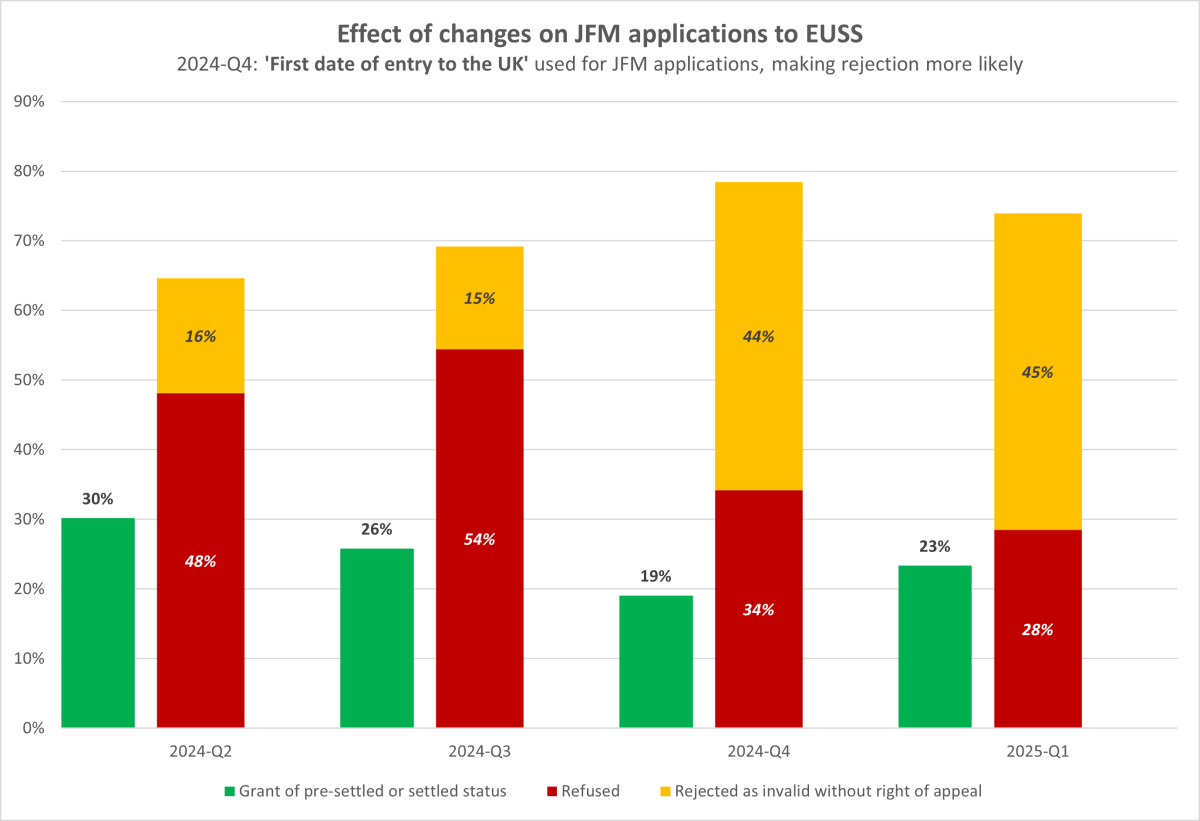
The Home Office changes the requirements for joining family members so that the application deadline is based on 3 months from their first arrival in the UK since 1 January 2021, rather than 3 months from their most recent arrival to the UK (or later where there are reasonable grounds for their delay).
- 31 December 2024 - BRCs and BRPs expire
All Biometric Residence Cards (BRCs) for non-EU citizens with EUSS status expire on 31 December 2024, regardless of the expiry date of their pre-settled status or whether they have settled status. The same is true for those who have immigration status outside the EUSS, who have Biometric Residence Permits (BRPs).
The Immigration Minister announced on 4 December that expired BRCs and BRPS can still be used for travel until 31 March 2025. Later, on 27 February 2025, she announced a final extension to this grace period, to 1 June 2025.
- January 2025 - Automated upgrades to settled status
The Home Office announced the introduction of a new process to automatically convert eligible pre-settled status holders to settled status, without the need for them to make a further EUSS application.
This automated process can only benefit EU/EEA/Swiss citizens who were resident in the UK before December 2020, and whose HMRC/DWP records show a 5-year residence footprint. These automated checks are the same as used when people apply for settled status, and their National Insurance number is used in automated checks against HMRC/DWP.
The automated process does not benefit family members, as they would also need to prove their family relationships have been maintained and this requires caseworking.
The announcement includes the following:
Later in 2025, the Home Office intends to expand this process to enable more eligible pre-settled status holders to benefit from it. We are also considering the appropriate next steps for cases where a pre-settled status holder no longer meets the conditions of their pre-settled status, for example because they have not remained continuously resident in the UK. Further information will be provided in due course.
- 1 April 2025 - the3million webinar for pre-settled status holders facing uncertainty
the3million held a webinar with Chris Benn, immigration expert from Seraphus, to discuss the situation of those pre-settled status holders who may have broken their continuity of residence, and who are therefore fearful that they may never be able to upgrade to settled status.
Note that the information in this webinar has now been superseded by the changes to the absence policy announced to take effect from 16 July 2025. However, you can still find our webpage with information that was available at the time here, and to watch back the webinar.
- 16 July 2025 - Major change to absence policy for pre-settled status holders
The Home Office announced changes to immigration changes to the immigration rules which will enable more EU citizens and family members with pre-settled status to be eligible for indefinite leave to remain (settled status) and continue to live in the UK.
People with pre-settled status will qualify for settled status when they’ve been resident in the UK for at least 30 months (2.5 years) in total in the most recent 60 month period (5 years).
Changes will apply from 16th July 2025 and will apply to the over 1.6m people with pre-settled status in the UK.
The3million had been raising the need to make significant changes directly to Home Office and Cabinet Office ministers, the EU Commission, and the Independent Monitoring Authority for a long time. In its announcement, the Home Office credit the work of us and others:
However, stakeholders have highlighted some confusion on the part of pre-settled status holders regarding permitted absences from the UK, which may have led some to inadvertently break their continuous residence in the UK (and thereby cease to be eligible for settled status) by exceeding the permitted absence(s) from the UK. To simplify the assessment of continuous residence, these changes enable a pre-settled status holder to be granted settled status where they have been resident in the UK for at least 30 months in total in the most recent 60-month period. This can be any 30 months within that 60-month period.
See here for our webpage with more information, and for information about a webinar held on 15 July 2025.
Updated EUSS Caseworker guidance sets out changes on page 181 under "Converting from pre-settled status to settled status – maintaining continuous residence".
- 16 July 2025 - EUSS Caseworker use of Home Office travel data
When people make an application for pre-settled or settled status, EUSS caseworkers will - from 16 July 2025 - also consult Home Office travel data if automated checks against tax and benefit data don't confirm their continuous residence. If possible, the travel data will be used to provide evidence of residence in the UK where there are gaps in the data from HMRC / DWP. This will hopefully reduce the amount of additional evidence that the applicant is asked to provide
Updated EUSS Caseworker guidance is published, and contains a new section "Home Office travel data" on page 182 with five example scenarios.
- 16 July 2025 - Pre-settled status holders who switched to another immigration route
If someone had pre-settled status, they may have gone on to obtain a different immigration status, for example they switched to a Student Visa, a Skilled Worker Visa, or obtained indefinite leave to remain as a Victim of Domestic Abuse. This can be for many reasons, including for example an immigration advisor telling you that you were unlikely to ever be eligible for settled status.
The updated EUSS Caseworker guidance explains that people in this position will have retained their pre-settled status alongside their other immigration status. So they can still apply for settled status, providing they meet the eligibility criteria - for example by using the '30 months out of the last 60 months' form of the continuous residence requirement.
The guidance says (on page 39) that there is no deadline for them to apply, and also explains (on page 68) that the pre-settled status will not show on their digital status while they have the other immigration status.
See also this Home Office guidance page Prove pre-settled status if you have another UK immigration status.
- 11 November 2025 - EUSS Caseworker Guidance includes policy on EUSS status granted 'in error'
Version 29.0 of the EUSS Caseworker Guidance introduces new sections "Relevant EEA citizen's EUSS status was granted in error" (page 102) and "Relevant sponsor's EUSS status was granted in error" (page 123).
These make clear that where the Home Office considers pre-settled status was granted in error, the pre-settled status will not be automatically extended and will instead expire at the end of its validity. Where the Home Office considers settled status was granted in error, the settled status will not lose their status however they will lose the right to sponsor a family member's EUSS application. In neither case is there a proportionality assessment before informing the status holder of the expiry of their status or their loss of sponsorship rights, nor does this loss of status or rights come with a right of appeal.
Later versions of the guidance set out more examples of when the Home Office considers status was granted in error, see version 32 published on 30 July 2026. This includes examples that the Home Office considers someone was not an EEA national on 31 December 2020, or that they were not resident in the UK by 31 December 2020.
- 30 December 2025 - Anyone with EUSS status can obtain an EUSS Travel Permit if needed
Before this change, EUSS Travel Permits were available for visa nationals with status under the EUSS whose Biometric Residence Card (BRC) was lost or stolen, in order to allow them to demonstrate to carriers their right to travel back to the UK.
In light of the strict enforcement of the Electronic Travel Authorisation (ETA) scheme from 25 February 2026, any EUSS status holder (not just visa national EUSS status holders) could now face problems returning to the UK if their eVisa is not correctly linked to their travel document. Therefore any person with EUSS status will now be able to obtain an EUSS travel permit.
See Explanatory memorandum to the Statement of Changes HC1491 which explains in paragraph 5.15: "The changes for the EUSS travel permit (in Appendix EU (Family Permit)) will enable all EUSS status holders to obtain an EUSS travel permit where they are unable to update their UK Visas and Immigration account, for example with the details of a new travel document, from outside the UK."
- 25 February 2026 - Non-visa nationals will get 'Permission to travel' with a Certificate of Application
Where a non-visa national who has made a valid application to the EUSS but is waiting for a decision and has a Certificate of Application (CoA), the Home Office systems should return a 'permission to travel' response to carriers. The Home Office have confirmed that these changes will be in place before Electronic Travel Authorisations (ETAs) are enforced from 25 February 2026.
This is confirmed in a letter to the3million, and in section 2.3 of Carrier Guidance.
However, this will only work if the passenger is travelling on the passport (or national identity document) that was used to make the EUSS application. If the applicant has since changed their travel document, they will not be able to link this to their UKVI account, because the system does not allow such updates while EUSS applications are in progress. People in this position will need to convince the carrier that they have permission to travel by logging into their UKVI account and showing their eVisa or giving a share code.
- 25 February 2026 - The Enforcement of Electronic Travel Authorisation (ETA)
From 25 February 2026, ETAs are to be fully enforced by carriers (airlines and train and ferry operators). This means that everyone must have permission to travel to the UK before boarding. This permission is in the form of an ETA (for non-visa nationals who are visitors to the UK), an eVisa, a British or Irish passport, or in some cases, acceptable physical proof.
Dual British nationals are impacted especially, as they must now travel to the UK on a British passport, as they are not eligible to apply for an ETA and they will not have an eVisa.
For more information, see:
- Statement made to Parliament by the Immigration Minister on 25 February 2026
- News story on Home Office website "No permission: no travel" on 24 November 2025
- Letters from the3million to Home Office, Cabinet Office and EU Commission about dual nationals impacted by the change
- 10 March 2026 - Dual nationals with EUSS status can continue to travel to the UK on their non-British passport
Two weeks after announcing that all dual British nationals must travel to the UK on their British passport, the Home Office made a concession for those dual nationals who previously had EUSS status before naturalising as British.
Home Office guidance says: "If you got British citizenship after settling in the UK under the EU Settlement Scheme, you can travel to the UK using a valid passport of your other nationality or national identity card from the EU, Norway, Iceland, Liechtenstein or Switzerland." Make sure your eVisa is still valid and your passport and identity document are linked to your eVisa.
- 31 March 2026 - Home Office funding of GFOs comes to an end
Since 2019, the Home Office provided funding to Grant Funded Organisations (GFOs) to help vulnerable citizens to obtain status under the EU Settlement Scheme. This came to an end on 31 March 2026. the3million and many other organisations made representations to the Home Office to continue the funding, and expand its scope to include helping people who receive communications from the Home Office about cancelling their EUSS status.
The Independent Monitoring Authority has also put out a statement: IMA Advises EUSS Applicants Still Need Support.
There was separate GFO funding for organisations to help people convert to digital-only status, this also came to an end on 31 March 2026.
- 9 April 2026 - EUSS Automation update
Phase 3 automation goes live on 9 April 2026.
The Home Office policy paper explains that if a pre-settled status holder can show 30 months residence out of the most recent 60 month period, they can be granted settled status even if their pre-settled status was previously considered to have lapsed through a long absence.
The automation system now uses the 30/60 rules for continuous residence, rather than the 6/12 rule.
Phase 3 automation will also start removing pre-settled status from people who they think have clearly ceased to maintain continuous residence in the UK.


