EU Settlement Scheme Statistics
Every quarter, we break down the Home Office’s statistics on the EU Settlement Scheme (EUSS) together with data available through Freedom of Information requests and trusted sources.
This analysis is compiled and updated quarterly by the3million.
This page has been updated with the EUSS statistics that were published on 27 August 2026, for data up to the end of June 2026 - see here for the Home Office charts and description.
- How many EU citizens are there in the UK?
As at 30 June 2026, the EU Settlement Scheme (EUSS) had received 8.94 million (8,941,726) applications out of which 8.84 million (8,837,667) were concluded.
These estimates are for applications, not applicants and include repeat applications from the same person. The Home Office estimates that 6.45 million individuals have applied to the scheme, made up of 5.8 million EU27 citizens, 64,900 EEA EFTA and Swiss citizens, and 540,600 non-EEA nationals.
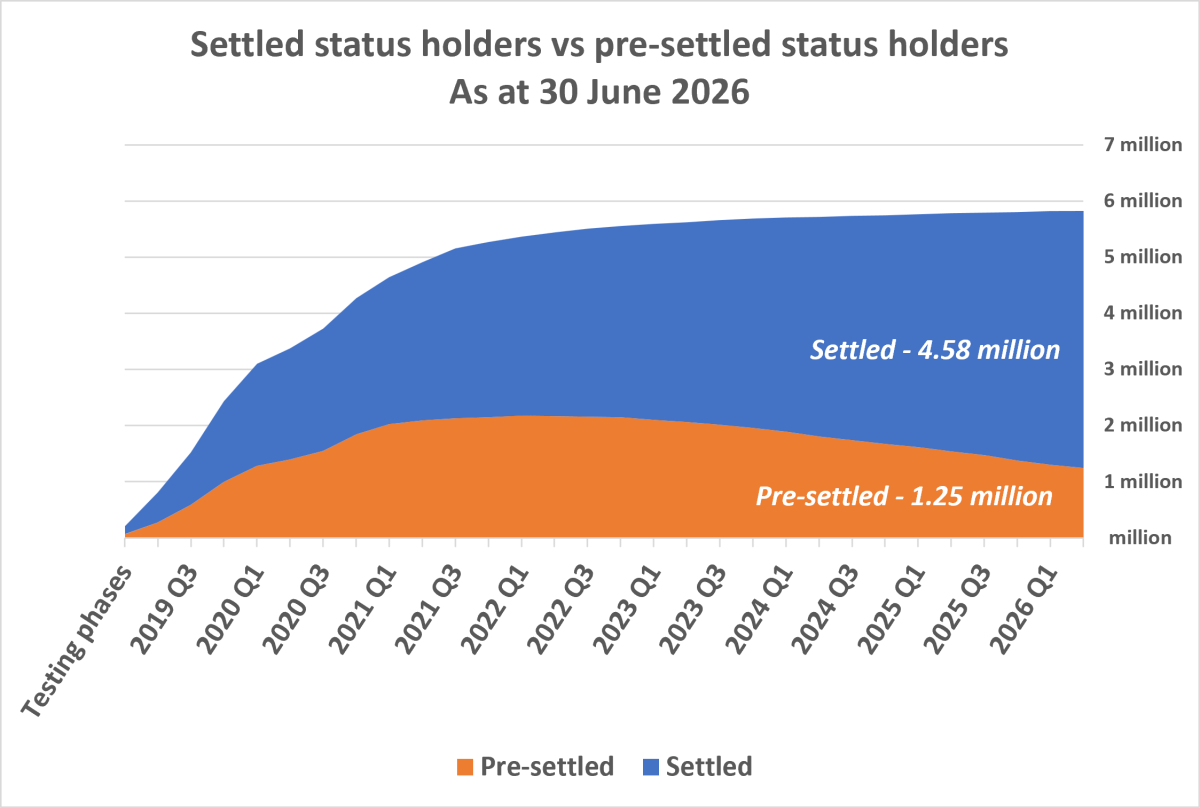
Out of these, approximately 5.8 million individuals have received a grant of status (4.58 million holding settled, and 1.25 million holding pre-settled status as at 30 June 2026).
The Census 2021 found that 3.6 million citizens resident in England and Wales were born in the European Union, an equivalent of 36.4% of all non-UK born residents.
The significant discrepancy in data comes from the fact the scheme opened in 2019 and there is an unknown number of people who no longer live in the UK.
Since 2021, EU citizens have also arrived in the UK on non-EUSS visas such as Skilled Worker, student, and other immigration routes. These visas are included in this analysis.
Source: Quarterly Statistics, June 2026 and Census 2021
- How many automated grants of settled status have been made?
In January 2025, the Home Office started a process of automatically converting certain eligible pre-settled status holders to settled status, without them having to make an EUSS application themselves. See this Home Office policy page for more details.
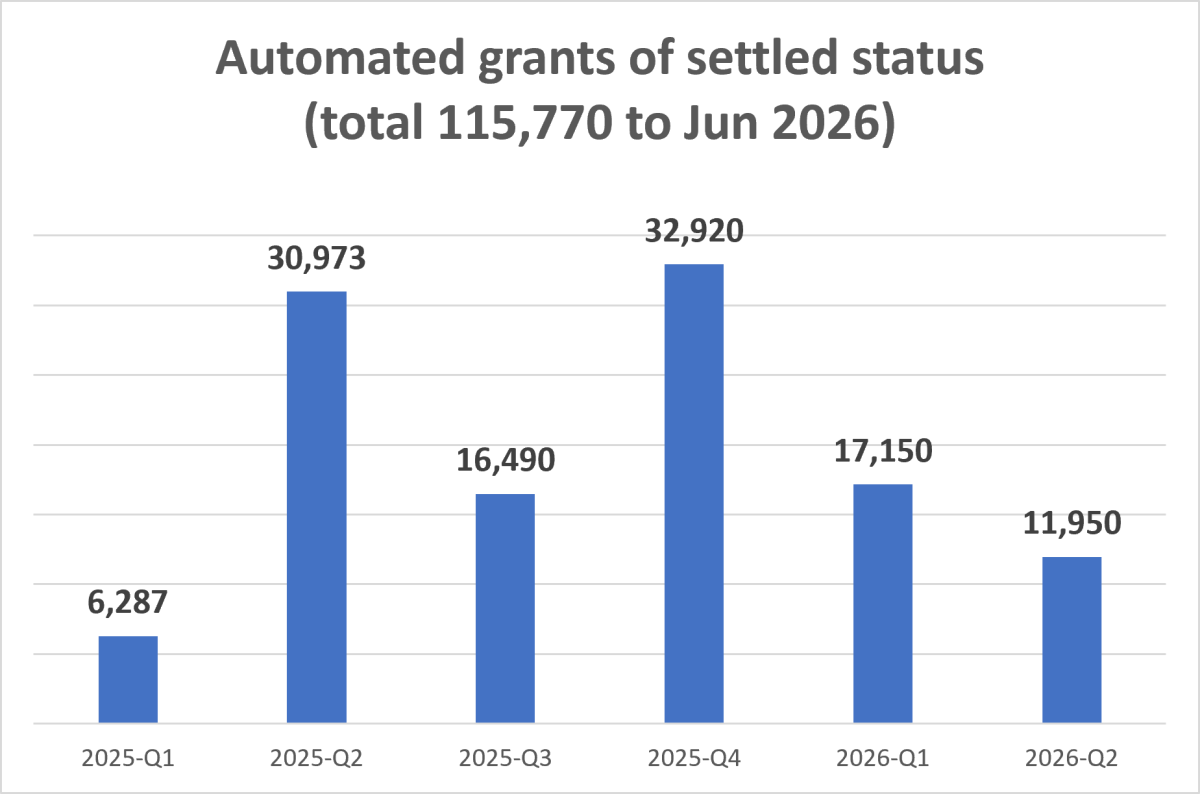
We do not know how many pre-settled status holders were considered for an automated grant, so we cannot tell what proportion of cases were successfully converted. By June 2026, there had been 115,770 automated grants of settled status. There were only 11,950 automated grants in the period April-June 2026, a drop from the previous quarter which was itself a significant drop from the quarter September-December 2025.
From 9 April 2026, the automated upgrade process was changed to look for 30 months residence in the preceding 60 months (rather than 6 months in every 12 month period), so we had hoped this might mean that future quarters see improved rates of automated upgrades to settled status. However, the most recent quarter to June 2026 does not yet bear that out.
These automated cases are not yet included in the published statistics data tables, and therefore do not form part of the numbers in the rest of this statistics page.
- What EUSS status do people hold?
Out of the 8.84 m applications concluded:
50.7 % - 4.48 m resulted in a grant of settled status - indefinite leave to remain
32.8 % - 2.90 m resulted in a grant of pre-settled status - limited leave to remain
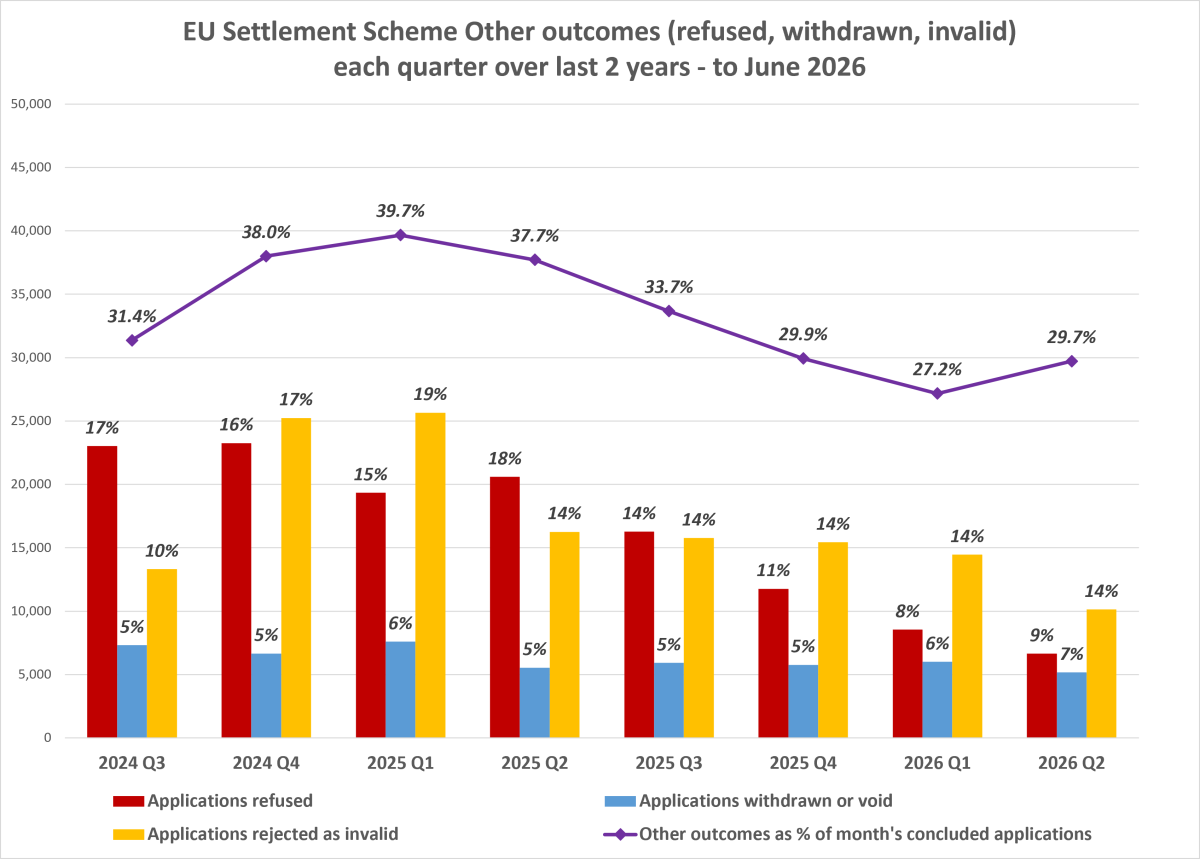
16.6% had other outcomes (841 k refused; 253 k withdrawn or void; 370 k invalid)
The number of pre-settled status holders is continuing to slowly come down. While some first time pre-settled grants are made to joining family members, other pre-settled status holders are submitting an EUSS application and being granted settled status. As explained in the section above, other pre-settled status may be automatically upgraded to settled status by the Home Office, without the need for an application.
As at the end of March 2026, there were an estimated 1,297,990 people with pre-settled status. An FOI shows a breakdown of this figure:
- 275,370 (21%) held pre-settled status as a joining family member (i.e. arriving after 31 December 2020)
- 1,022,620 (79%) held pre-settled status not as a JFM (i.e. having arrived in the UK by 31 December 2020).
Approximately a third of concluded applications do not result in a grant of status.
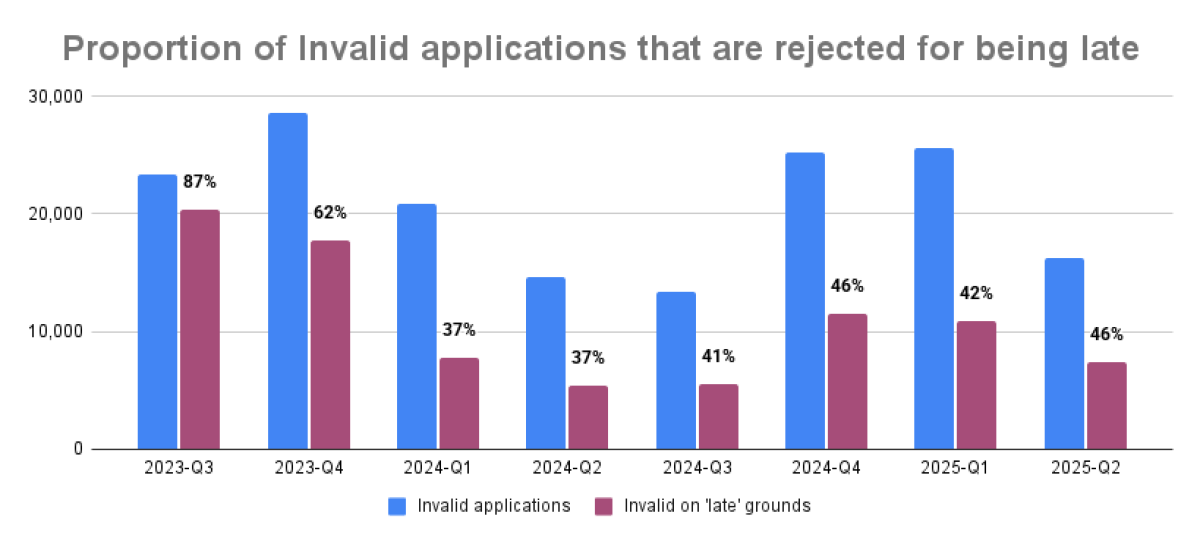
An FOI response looked at the EUSS applications that were rejected as invalid up to June 2025, and shows the proportion of those rejections that were rejected on the grounds of being late. Other reasons for rejections can include not proving one's identity as an EEA/Swiss citizen or one's relationship with a sponsoring family member. Between 2024 Q1 and 2025 Q2, approximately 40-45% of invalid applications were rejected as invalid on the grounds of being late (i.e. not demonstrating 'reasonable grounds' for having missed the deadline).
- WHO IS MAKING EUSS APPLICATIONS SINCE JUNE 2021 DEADLINE?
Since the EU Settlement Scheme deadline of 30th June 2021, almost 2.9 million applications have been made to the Scheme. There are still an average of over 21,000 applications made every month. These are made up of four main groups:
- Late applications - those who missed the deadline
- Repeat applications - mainly upgrades from pre-settled to settled status
- Joining family members
- Derivate rights applications
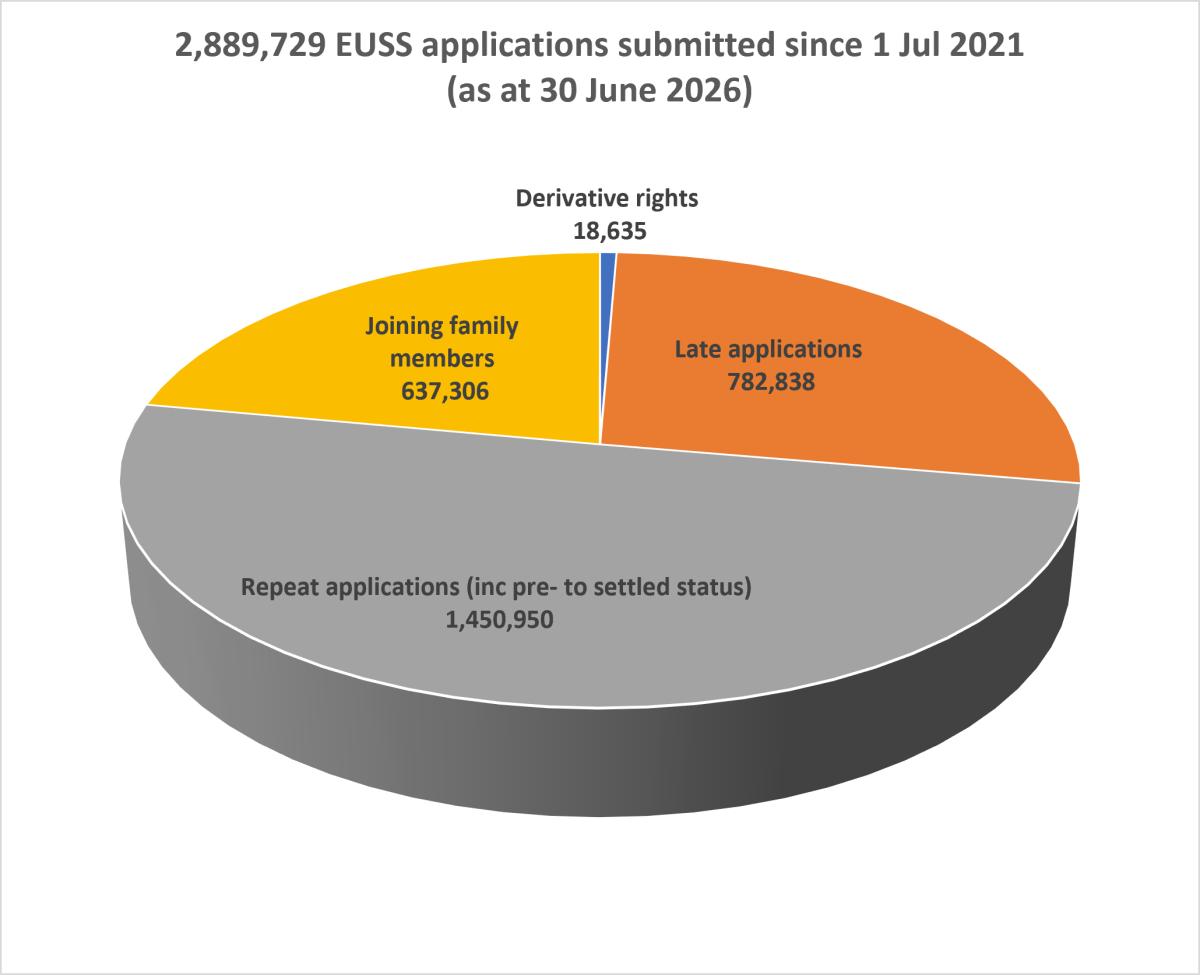
The following chart summarises the volume and breakdown between the different types of EUSS applications since the June 2021 deadline.
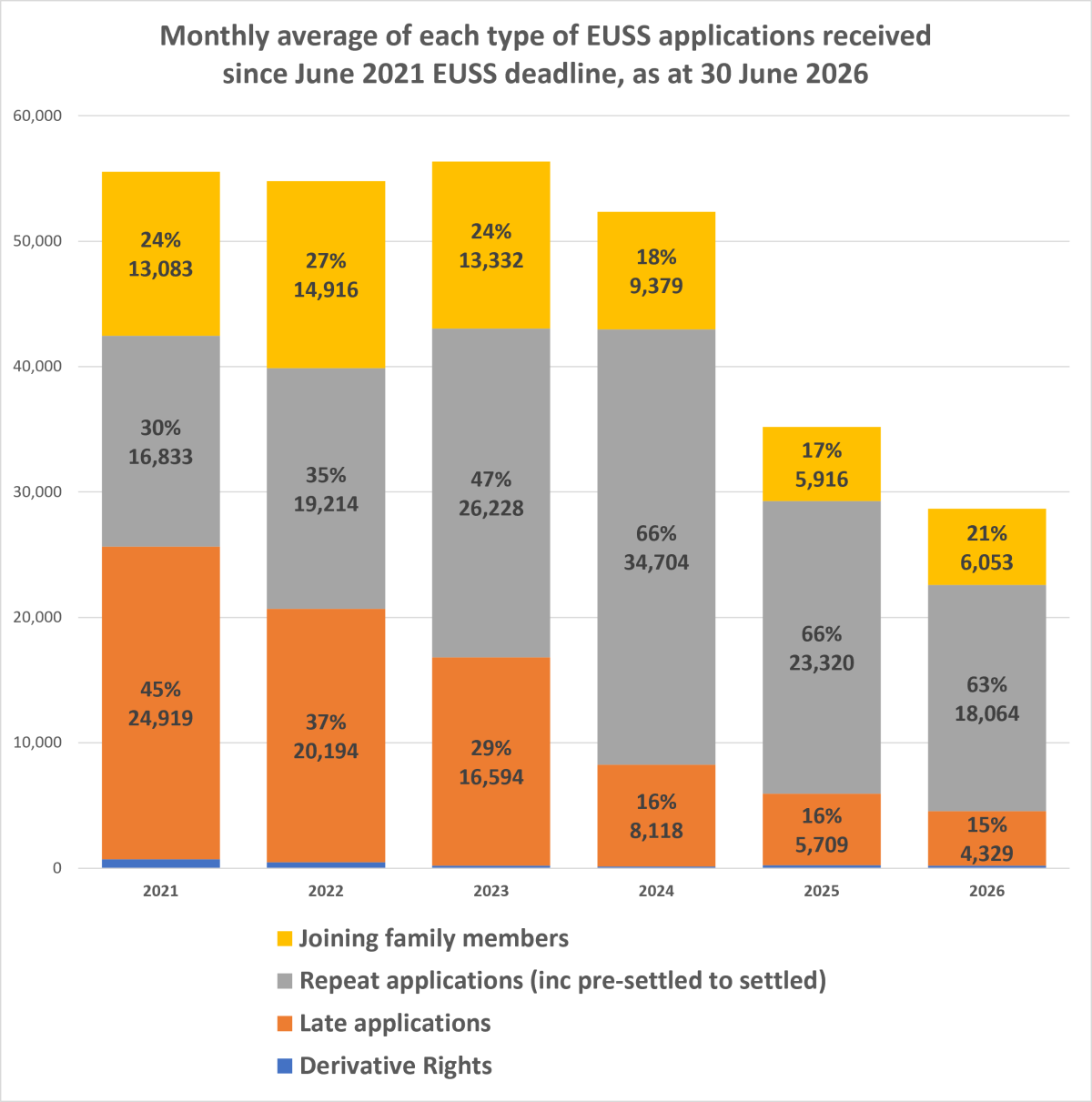
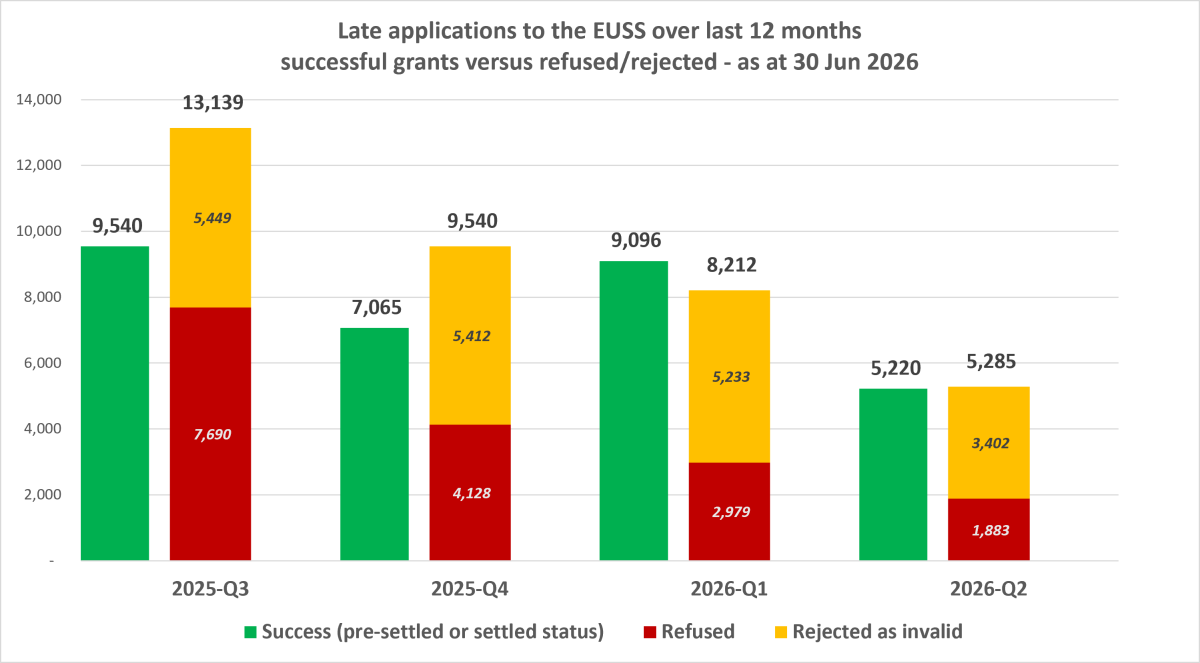
Late applications: Although the deadline to apply was 30th June 2021, the Home Office accepts late applications from EU citizens who were resident in the UK before 31st Dec 2020, or from joining family members (JFMs) who did not make an application by the time they had been in the UK for three months. (Note, late applications from joining family members are included in the JFM statistics, not in the Late statistics).
In the 5 years since the June 2021 deadline, there have been over 295,000 grants of pre-settled or settled status under the scheme following a late application. This shows clearly that a high number of people who have rights under the Withdrawal Agreement would have become undocumented without the significant concession of allowing late applications.
This is on average 4,930 successful late applications per month for each of the 60 months since the deadline.
Note, in August 2023, a very significant change was made to how late applications are processed, it is strongly recommended to seek legal advice when making a late application. See this FAQ for more information.
Repeat applications (mainly upgrades from pre-settled to settled status): Pre-settled status holders can apply for settled status to get confirmation of their right to stay in the UK indefinitely (as long as they don't then have a 5-year (4-year for Swiss) absence from the UK). This second application can be more difficult and complex, as EU citizens have to submit evidence of their 5 year continuous residency.
Since July 2025, people can satisfy continuous residence if they were resident in the UK for 30 months out of the last 60 months - see here for more details.
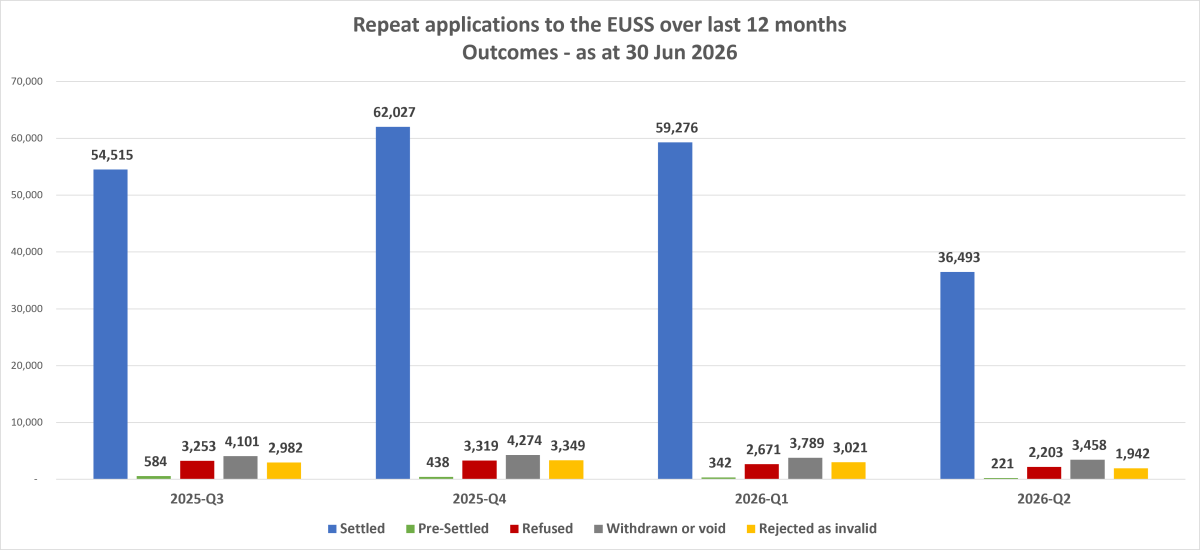
Joining family members: EU/EEA and Swiss citizens who lived in the UK before 31st Dec 2020 have rights to family reunion. Their eligible family members can apply and gain status through the EU Settlement Scheme.Joining family members will be required to apply to the EUSS within three months of their first arrival in the UK since 31 December 2020, or show that they have reasonable grounds for making a ‘late’ application. Note the EUSS Caseworker guidance does say there are normally 'reasonable grounds' for such a late application if the applicant previously only visited without intending to stay in the UK.
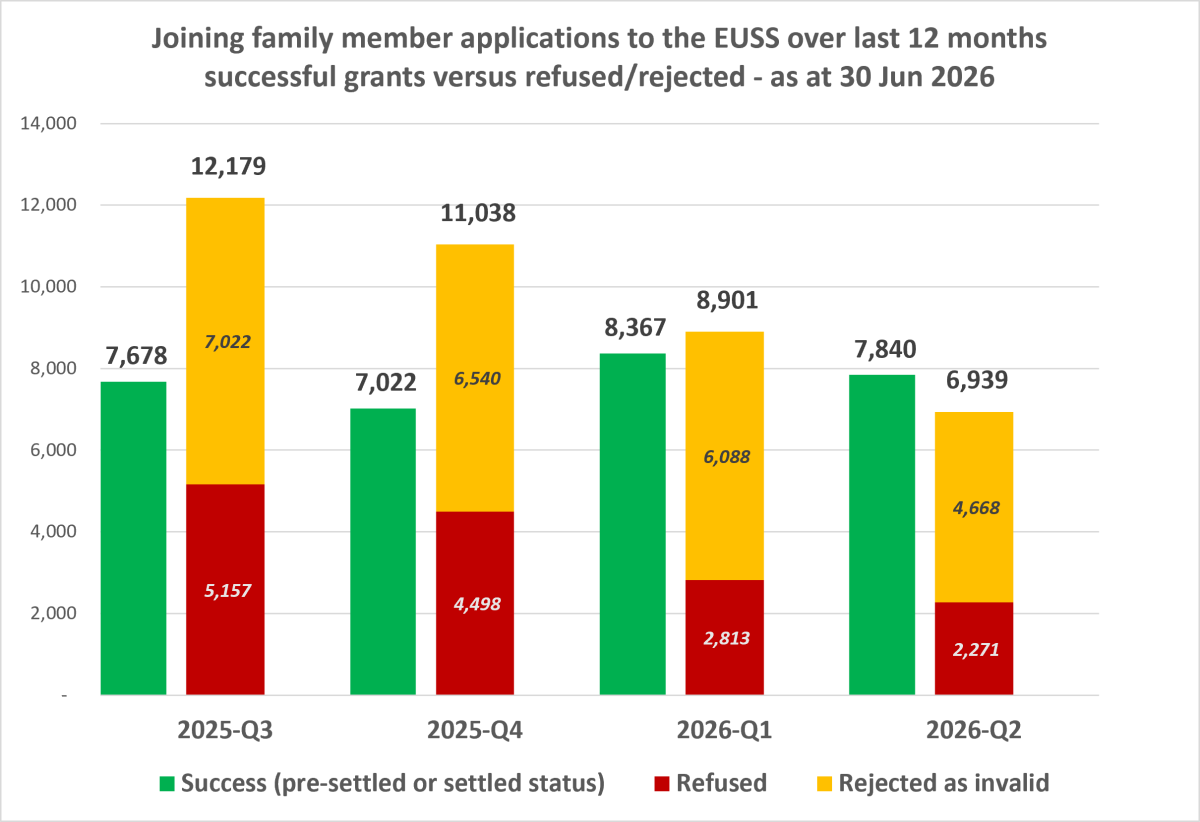
Derivative rights: This includes family members of certain British citizens (Surinder Singh and Lounes dual nationals), and adult carers whose rights are linked to the rights of residence of a British or EU national child.
- Who is waiting in the EUSS backlog?
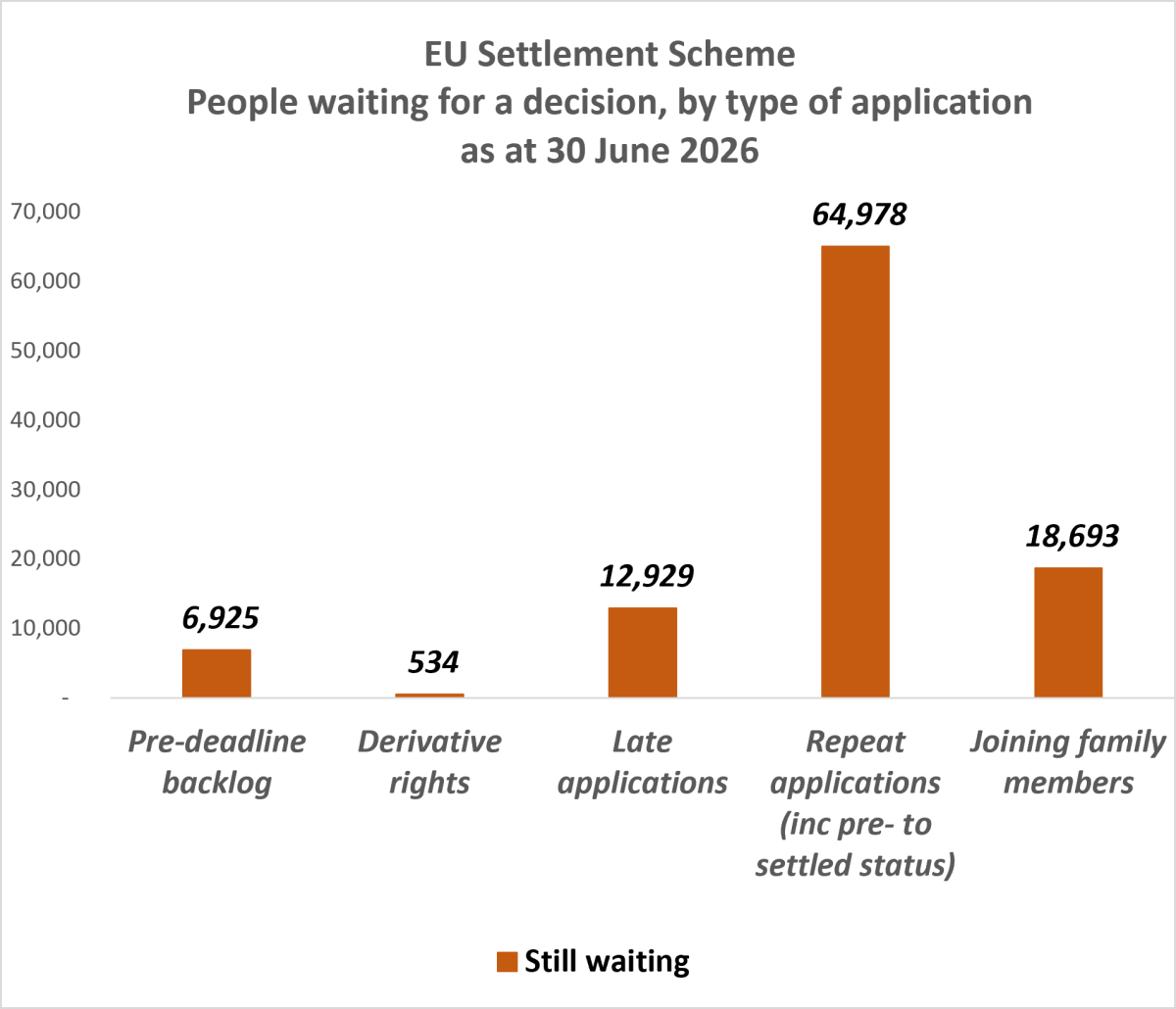
People waiting in the EU Settlement Scheme backlog fall into the following five categories:
- The four categories set out in the previous section who are still able to make applications after 30 June 2021:
- Late applications - those who missed the deadline
- Repeat applications - mainly upgrades from pre-settled to settled status
- Joining family members
- Derivate rights applications
- Pre-deadline applications made by 30 June 2021
The pre-deadline backlog is made up of people who applied in time, on or before June 2021, but who are still waiting. By our interpretation of the published statistics, there are still over 6,900 people who applied in time - at least five years ago - and who have yet to receive a decision. This does not include those who received a refusal, submitted an appeal and are awaiting the outcome of their appeal process.
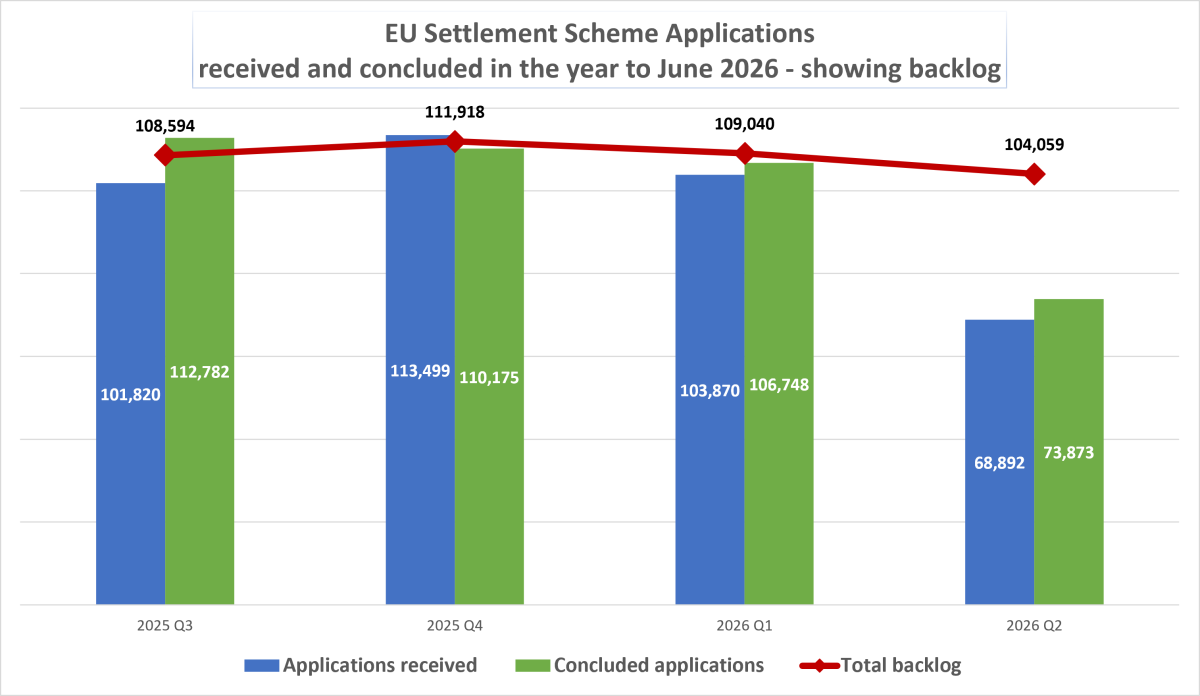
The applications backlog - or 'work-in-progress' - is fairly steady at over 100,000.
- The four categories set out in the previous section who are still able to make applications after 30 June 2021:
- How long have people been waiting in the EUSS backlog?
The Home Office does not publish data on processing times or waiting times, so what we know has been obtained through Freedom of Information requests.
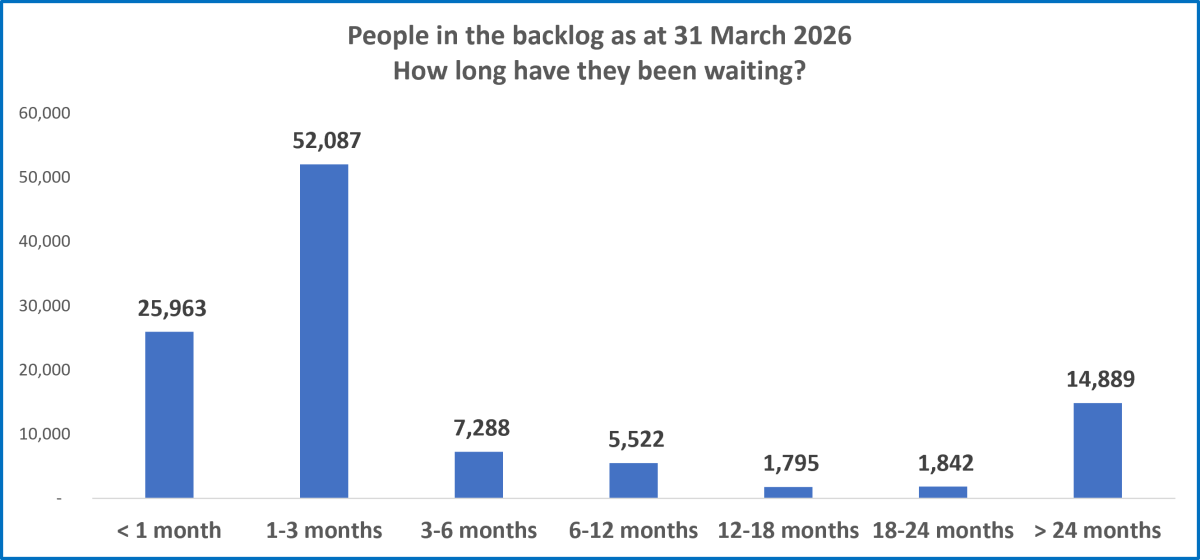
The make-up of the backlog has changed over time, as the following graphs show.
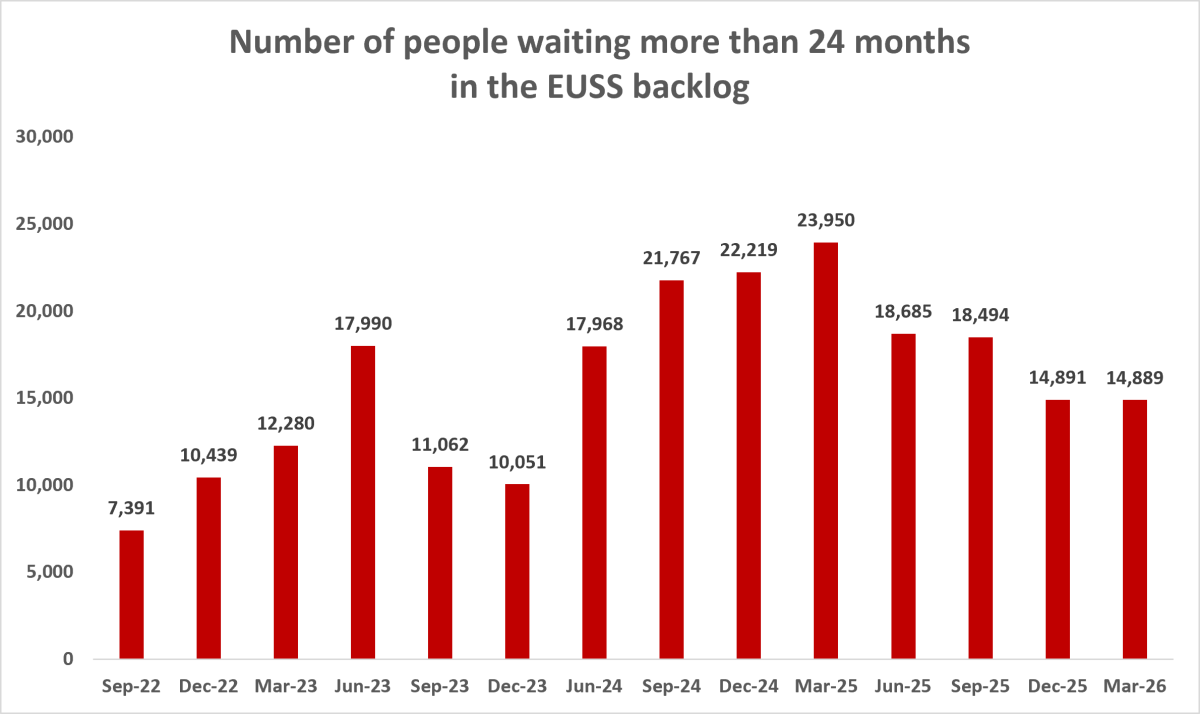
As at 31 March 2026, our latest FOI, 14,889 individuals had been waiting for over 2 years for their decision. Around 18,500 people had been waiting longer than a year, and over 24,000 had been waiting for more than six months.
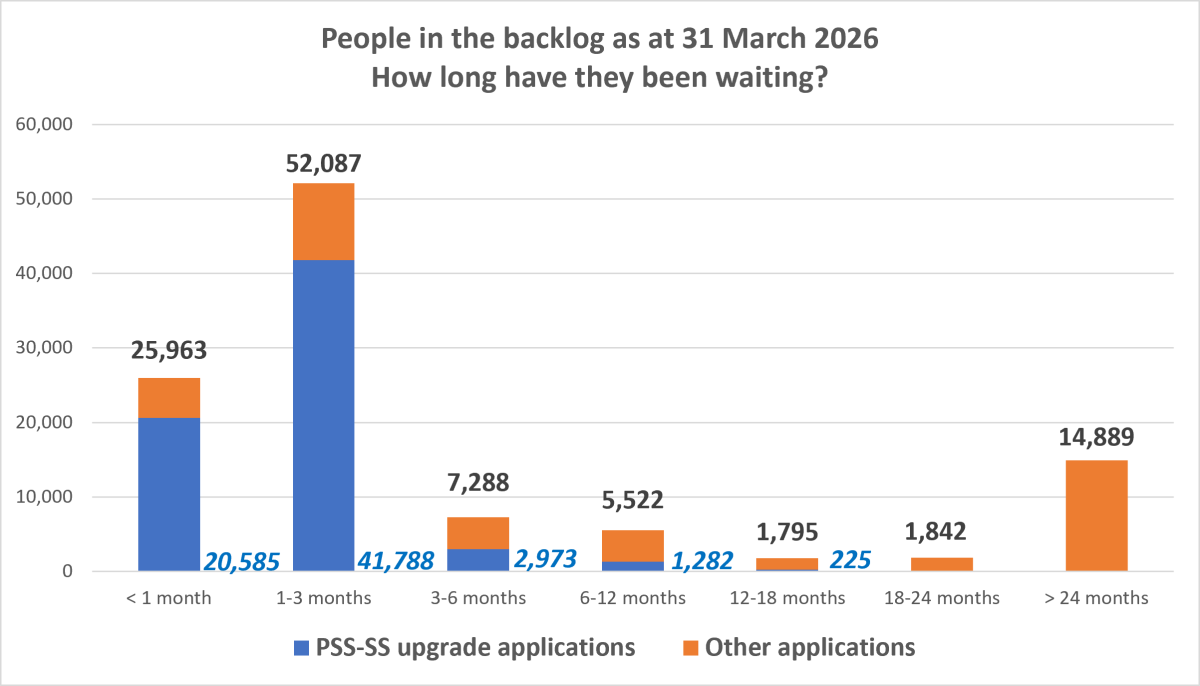
The following chart shows how each of the backlog waiting time figures is broken down between those with pre-settled status applying to upgrade to settled status, and those with other applications. As at 31 March 2026, there were a total of 66,853 people with pre-settled status who had applied for settled status and were still waiting for a decision. The vast majority (63%) had already been waiting between 1 and 3 months for a decision. 225 individuals had already been waiting for more than a year.
The number of cases pending for more than two years had is lower than at its peak, but for the last 2 years it has remained above 14,800.
- How long does it take to receive an EUSS decision?
The Home Office does not publish data on processing times, so what we know has been obtained through Freedom of Information requests. In recent quarters, we have been unable to receive these FOIs in a timely fashion, despite escalations to the Information Commissioner's Office (ICO).
The website entitled EU Settlement Scheme: current estimated processing times for applications states “It may take one month to decide applications where UKVI does not need to ask for more information or do further checks.”
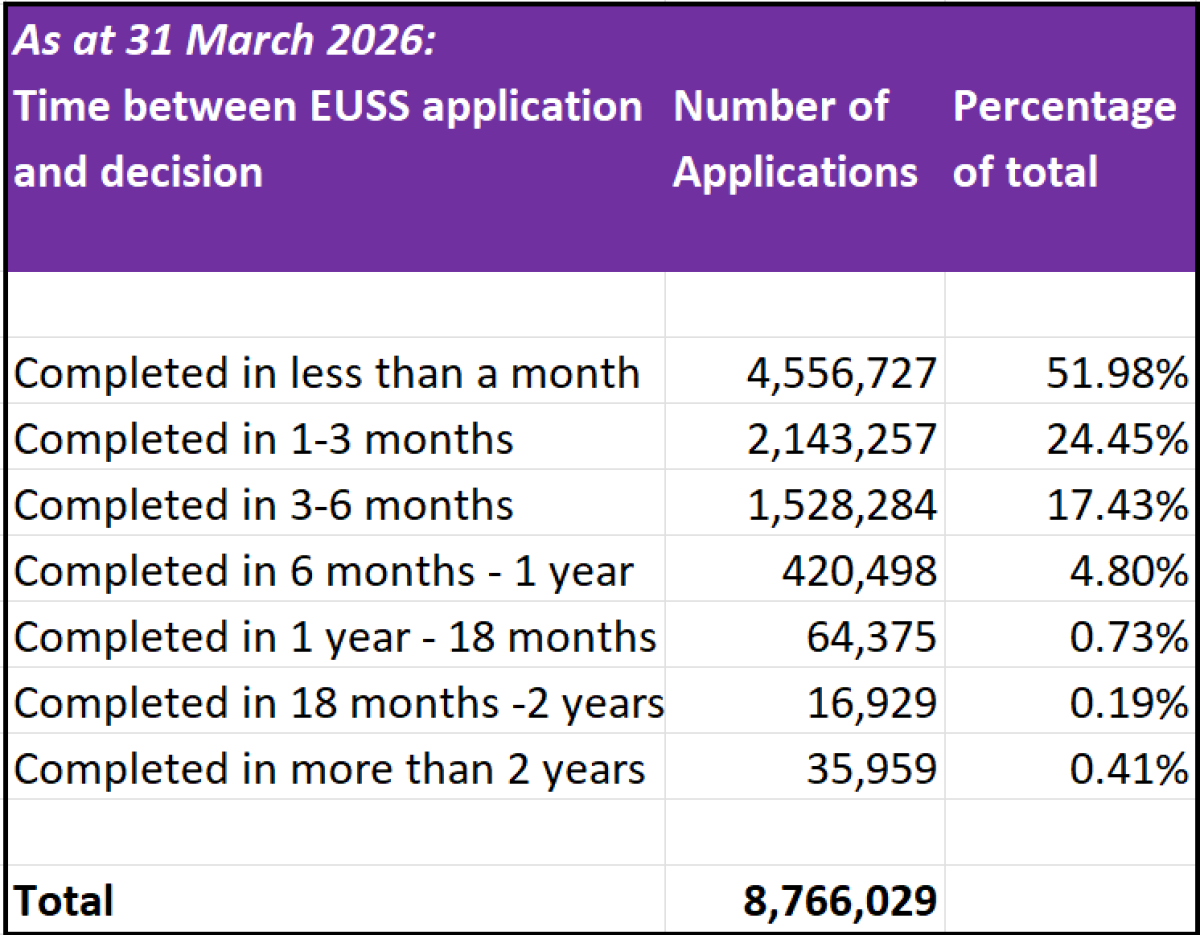
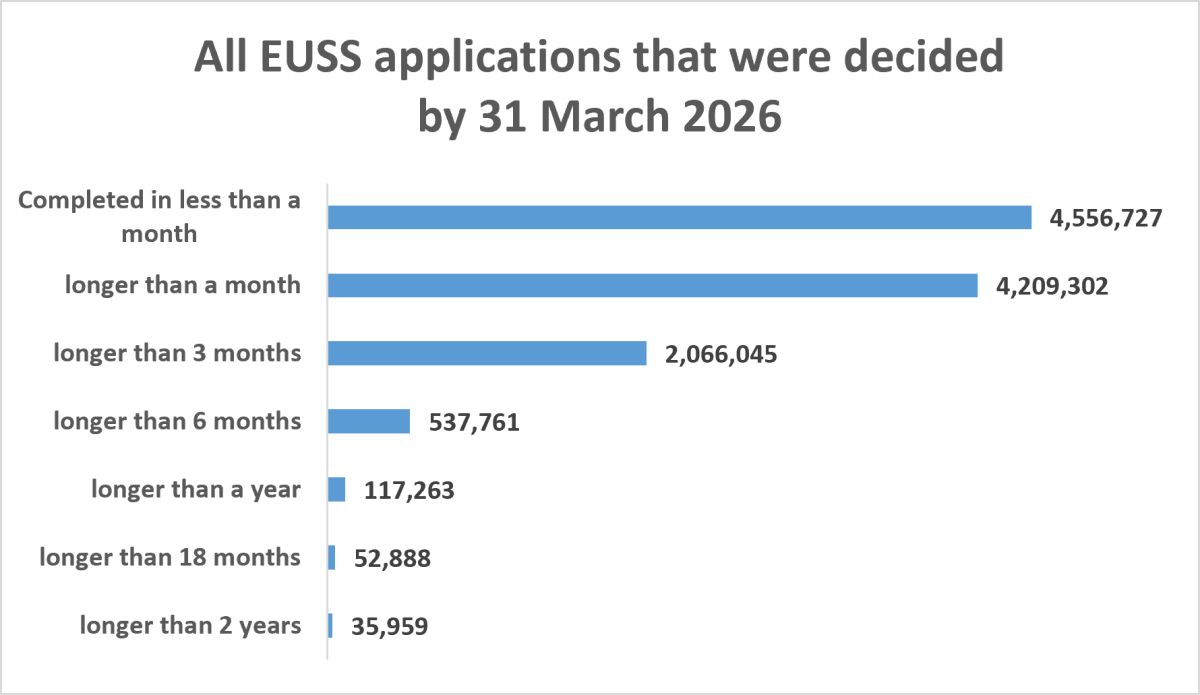
Over the lifetime of the EU Settlement Scheme (as at the end of March 2026, our latest FOI), 52% of applications were completed in less than a month, and 1.3% of applications took more than a year.
However, by comparing the figures from the latest FOI with those obtained in earlier FOIs, we can see that decision making is now much slower than at the start of the scheme.
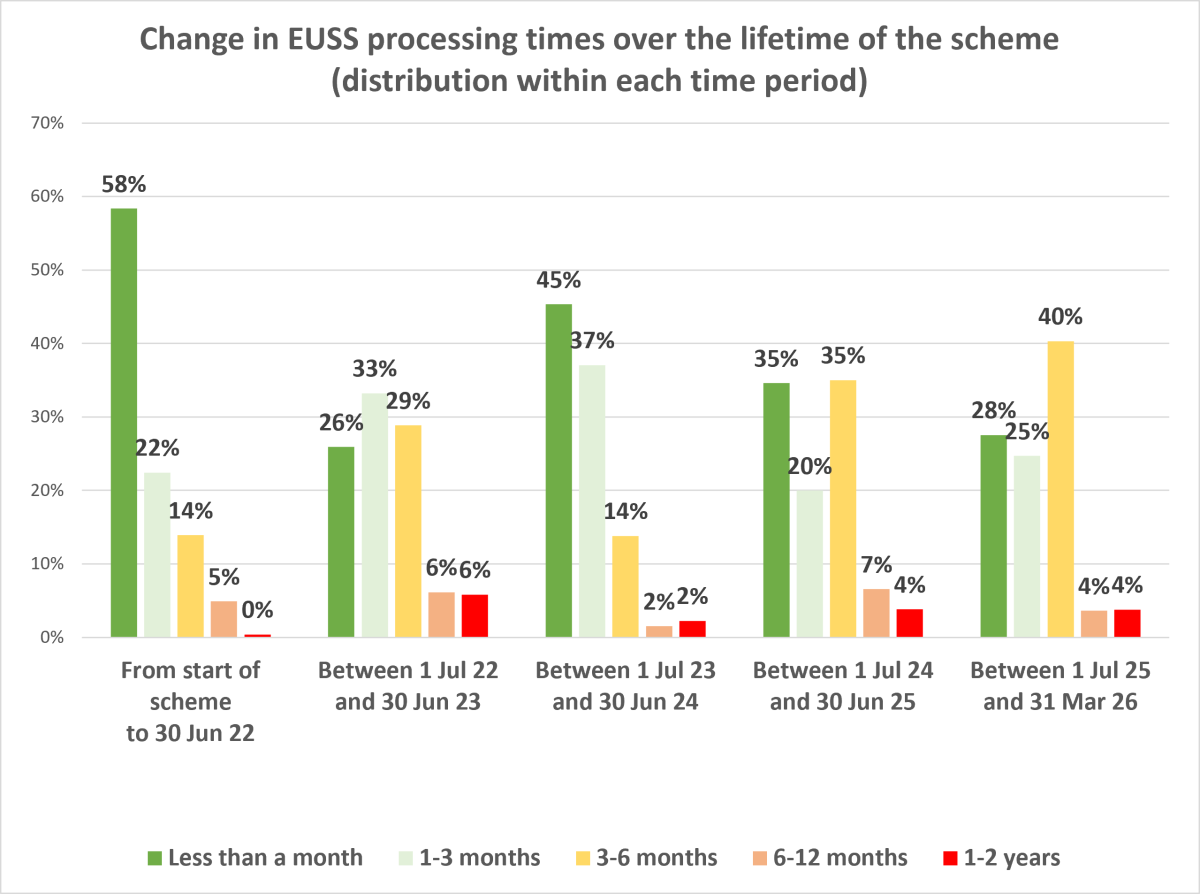
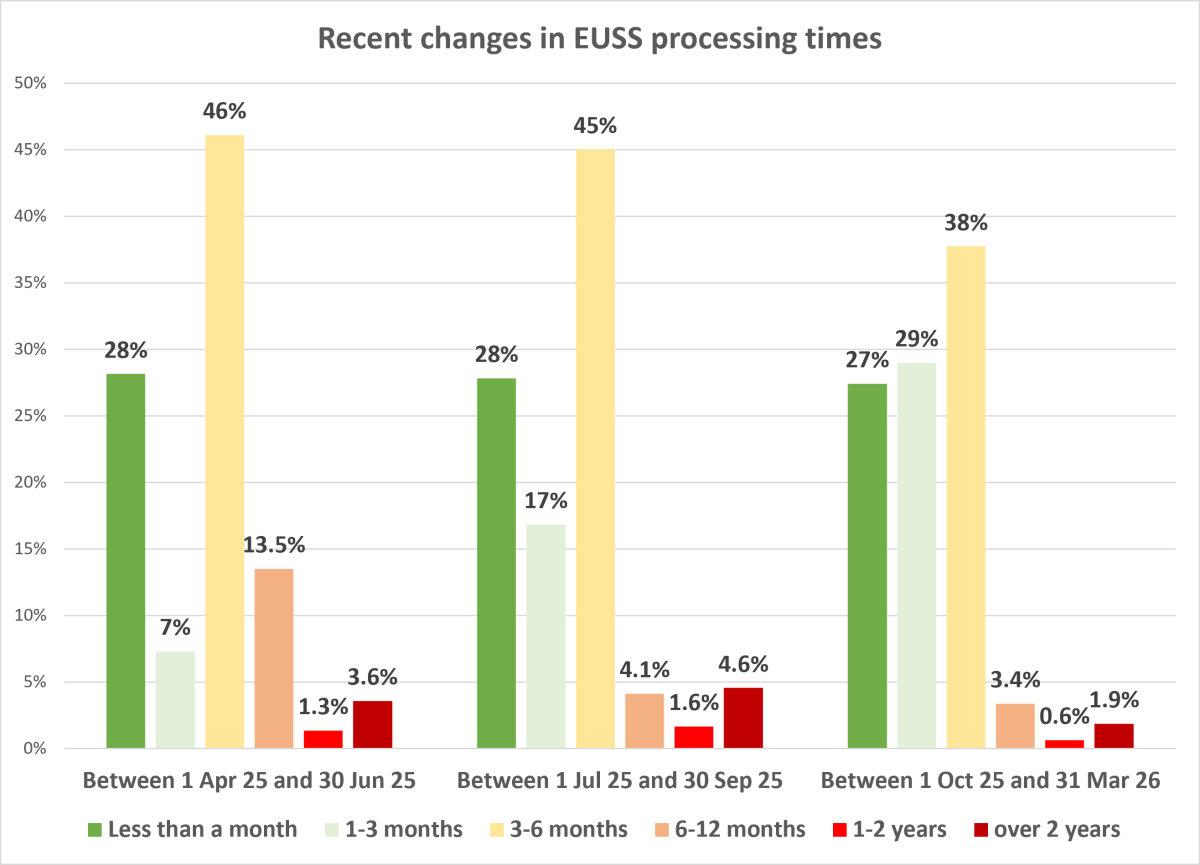
The following chart shows that although 58% of EUSS decisions by 30 Jun 2022 were made within a month, only 28% of more recent decisions (in the quarter from July 2025 to March 2026) were made within a month.
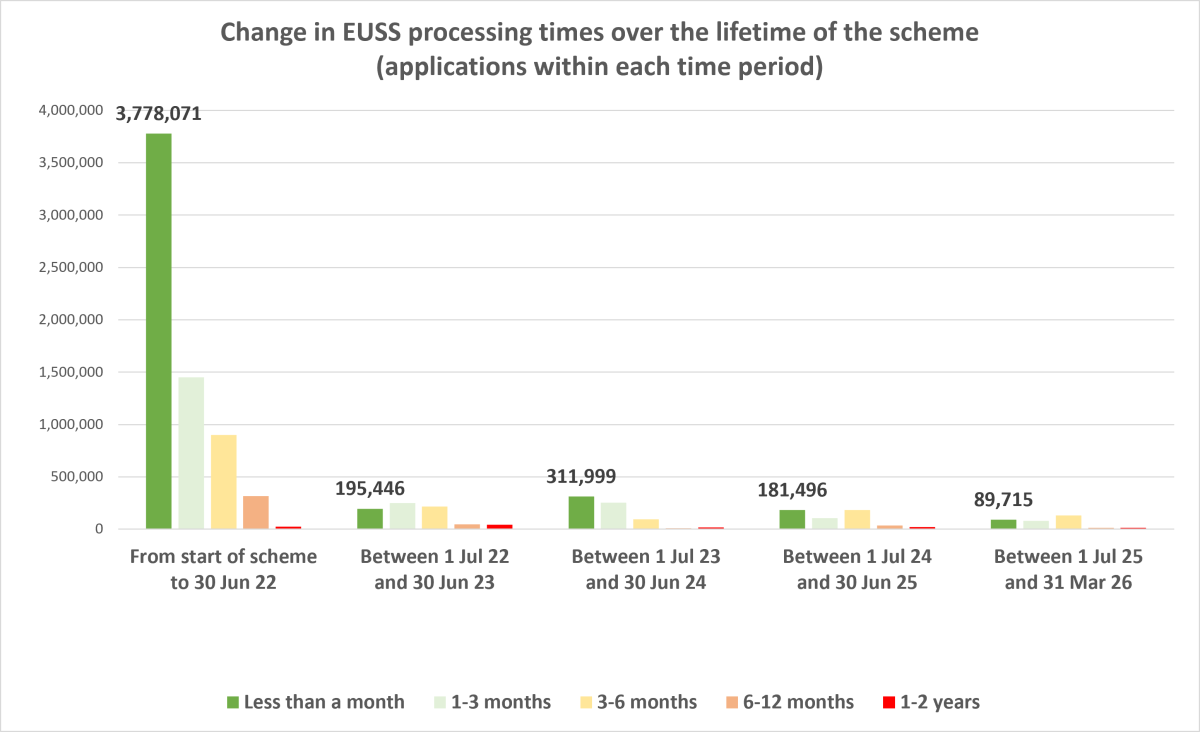
When we look at the actual number of EUSS decisions, it is clear that the vast majority were made in the earlier years, which makes that faster response time from the earlier years have a disproportionate weight when looking at the average response times over the lifetime of the scheme.
The following chart excludes the period before June 2022, in order to be able to see the change in processing times by year more clearly.
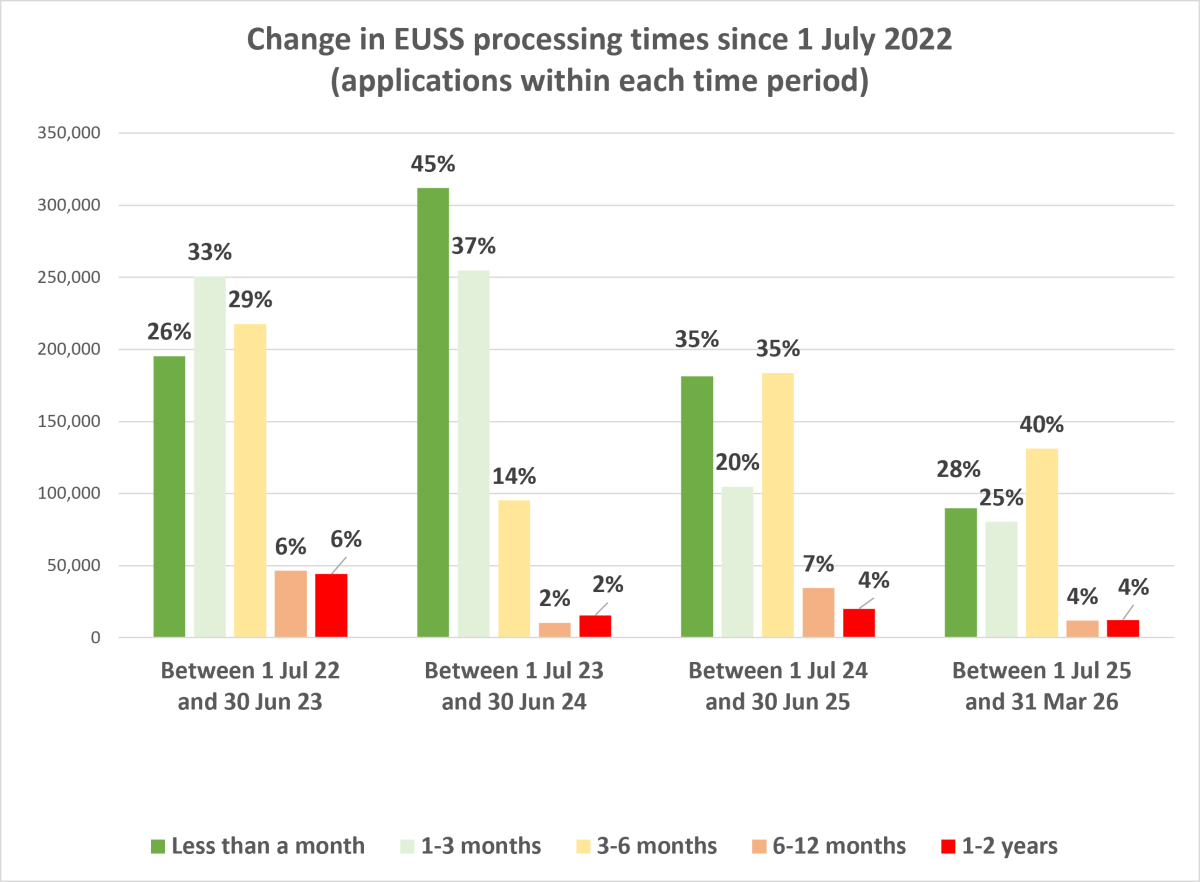
And finally the following chart takes a more fine-grained look at the changes in processing times over recent quarters. It shows processing times improving silghtly.
- What happens when people challenge an EUSS refusal via Administrative Review?
It used to be possible to challenge an EUSS refusal decision by submitting an Administrative Review (AR), however since April 2024 this is no longer possible. An AR was a way to ask the Home Office to look again at the application, without having to incur the costs and stress of submitting an appeal via the Immigration tribunal.
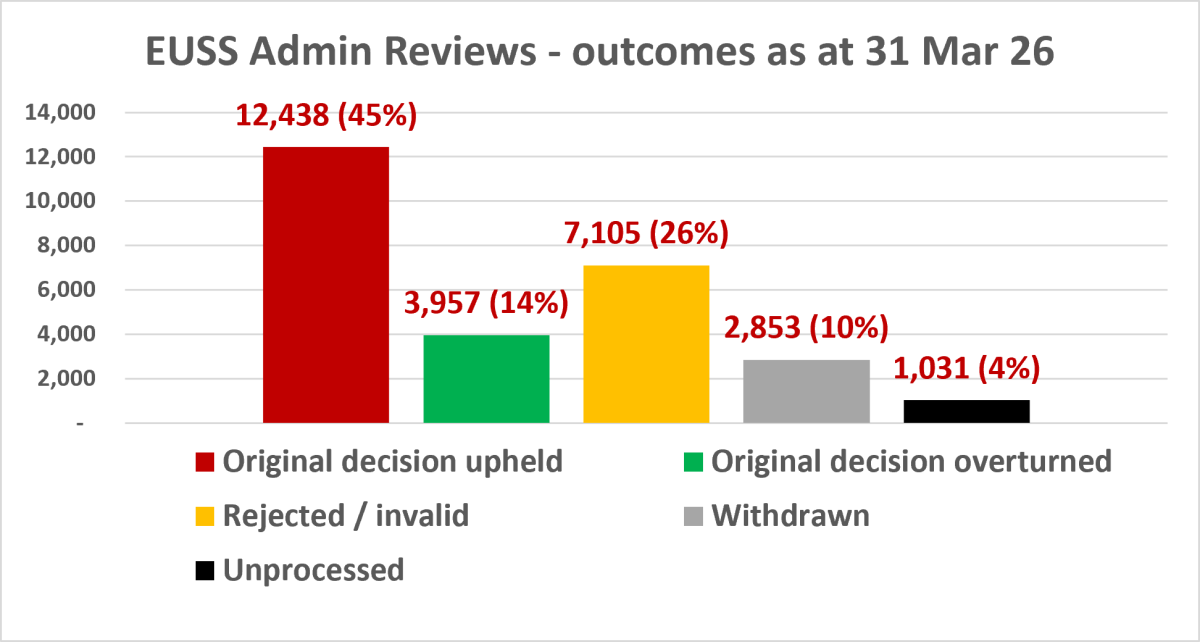
Around 27,000 ARs had been submitted, and when the scheme closed in April 2024, there was a backlog of somewhere between 11,000 and 12,000 unprocessed applications.
In June 2026, we were told that all ARs had finally been cleared. Below, we have included a chart showing the distribution of processing times. The majority - almost 14,000 applications - took between 2 to 3 years to be decided. It is important to remember the initial promise that an Administrative Review should be decided within 28 days.
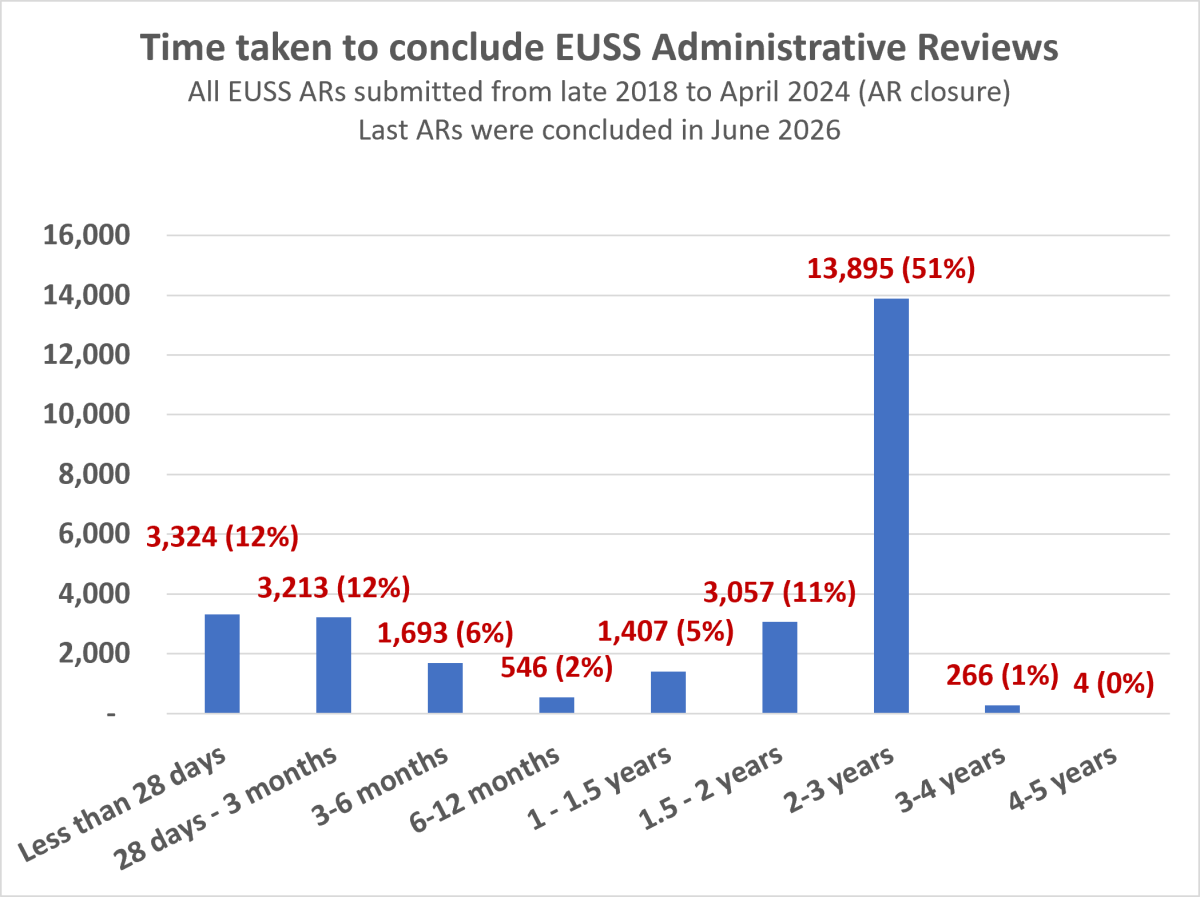
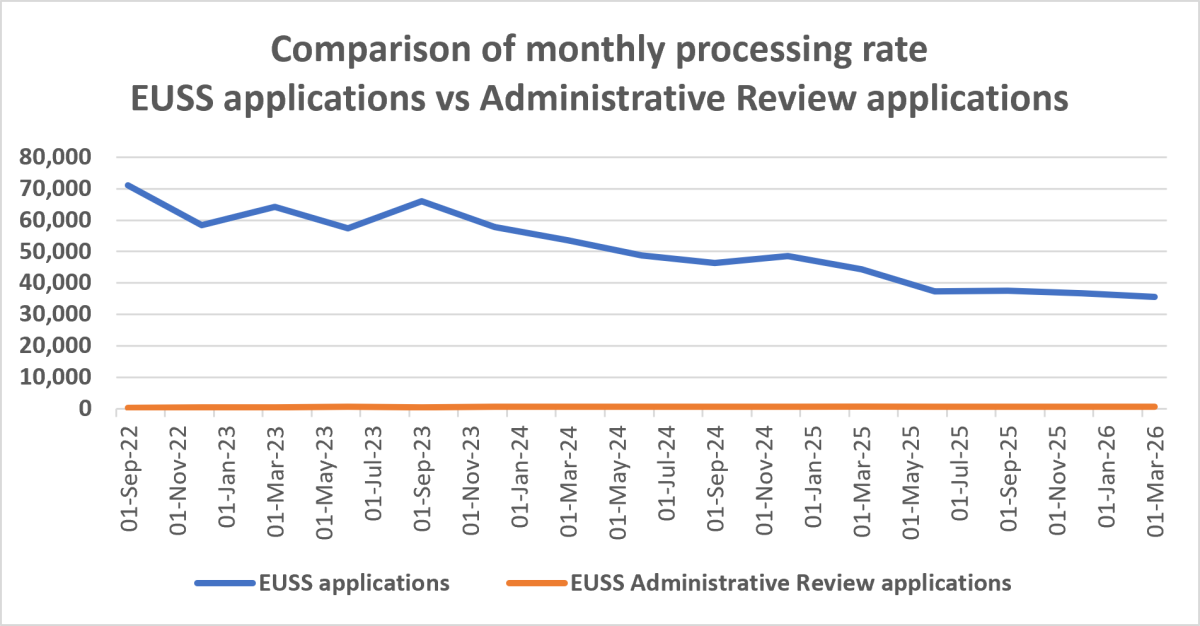
It is extremely disappointing that it took the Home Office AR review team until June 2026 - over two years - to process these remaining ARs. They were processed at an average rate of around 500 per month. When compared to the main EUSS processing rate over the same 2-year period of around 42,000 a month, it is clear that insufficient Home Office capacity was put towards clearing ARs.
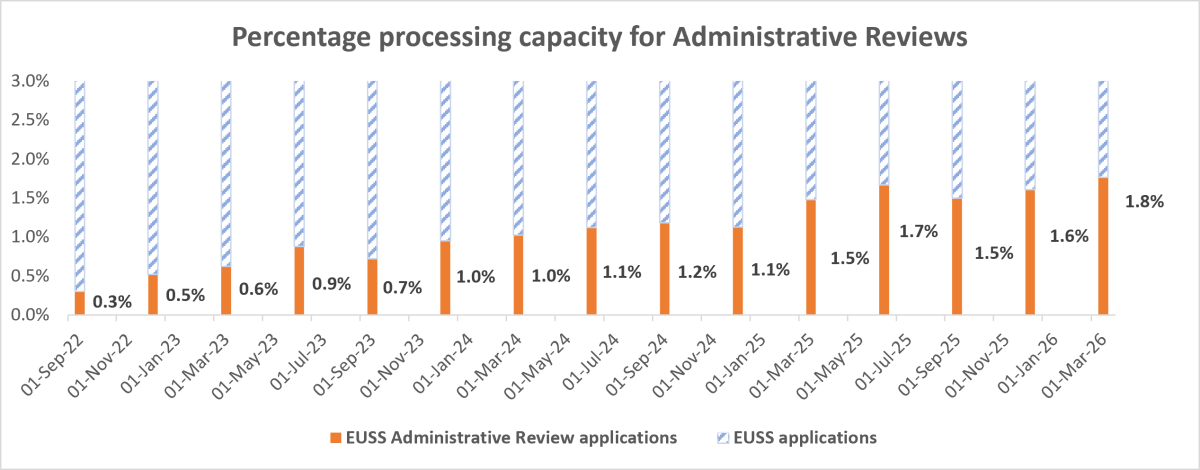
It is difficult to compare the processing rates on a chart, as the scale of difference is so significant. It visually implies that the monthly processing rates of ARs was zero. Therefore we have also published a chart showing the percentage of the Home Office EUSS processing capacity that was allocated to EUSS Administrative Reviews (compared to processing EUSS applications). It shows that the percentage processing capacity was never above 1.8% - and then only in early 2026 when there appeared to be an effort to finally clear the backlog.
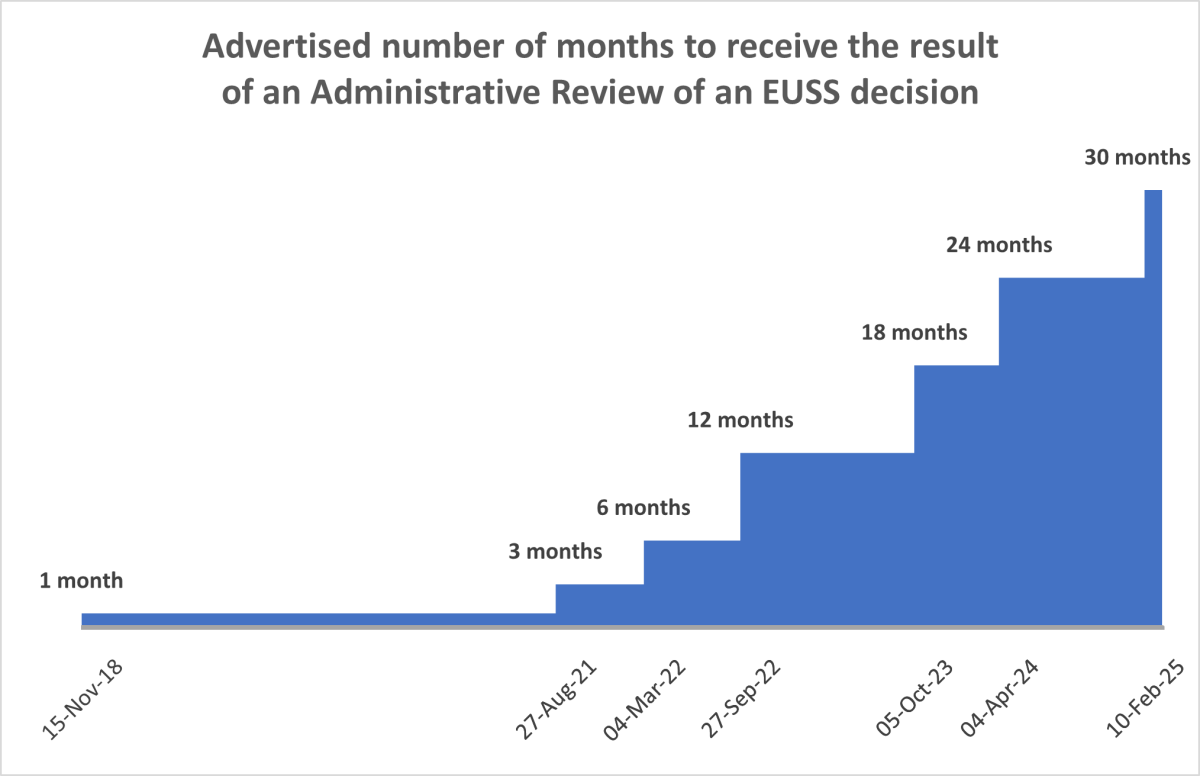
Published waiting times for AR decisions steadily increased, and since February 2025 the Home Office stated they were taking over 30 months (two and half years!). A chart below shows how much this advertising waiting time (on the Government's EUSS AR website) changed over time, from just 1 month when the EUSS was first opened.
Over the past few years we spoke to many people in this situation, who reported feeling very anxious and stuck. The Home Office does not advise people waiting for a decision to travel (a policy the3million disagrees with), so this extended in limbo period was having devastating impact for those facing unreasonably long waits for an AR. Furthermore, when someone's AR did finally get processed, individuals suddenly unexpectedly received requests for further evidence with a very short period of time in which to respond.
Source - FOI.
- What happens when people challenge an EUSS refusal via appeal?
When people believe they have unfairly been refused status under the EU Settlement Scheme, they can appeal this to the First Tier Immigration tribunal (FTT). If someone has applied for an Administrative Review (AR) and received a negative decision on that AR, they can then submit an appeal.
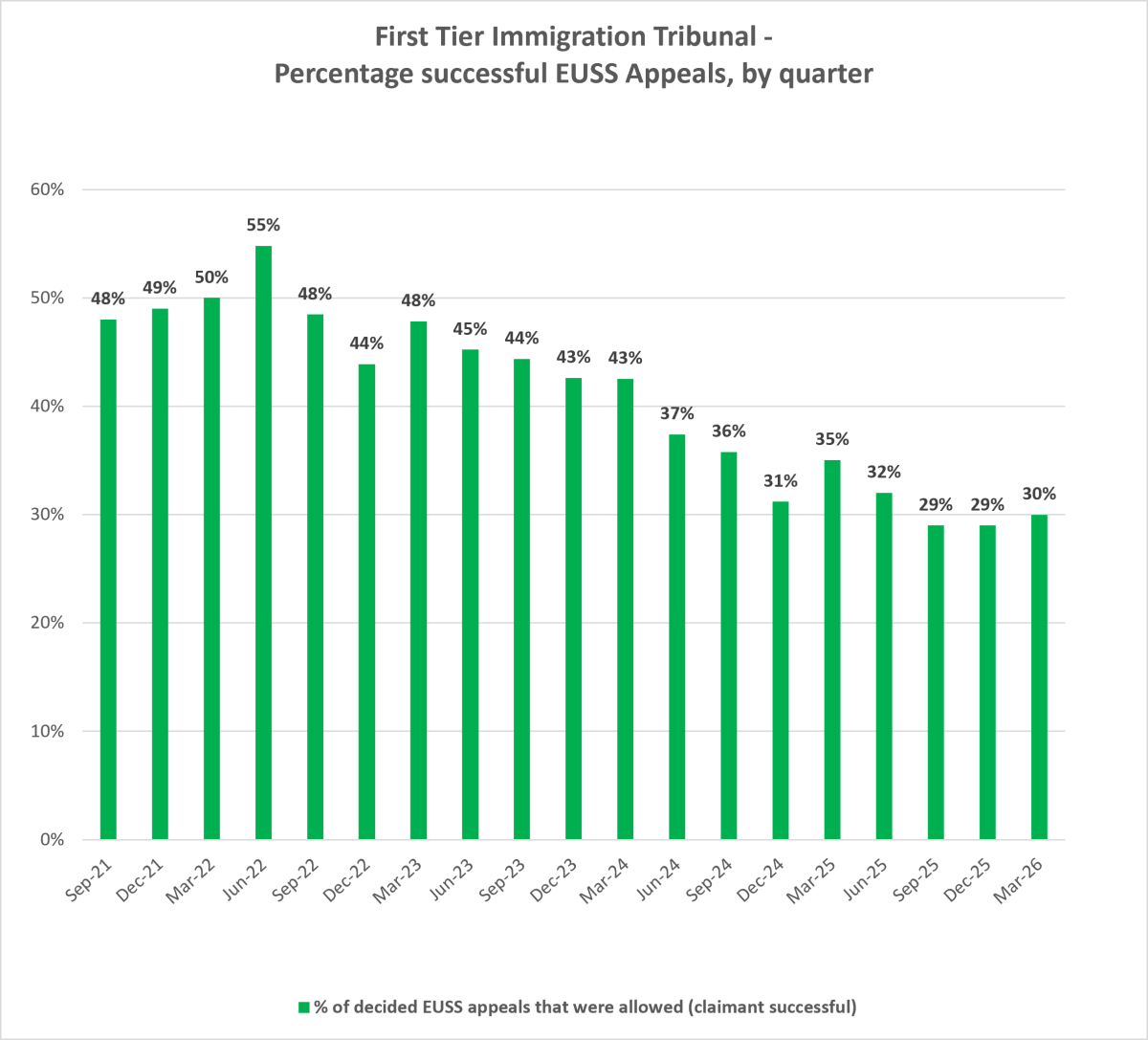
Published statistics by the Ministry of Justice show that each quarter, approximately between 30% and 50% of appeals result in the EUSS refusal being overturned, though this rate has been steadily declining over time.
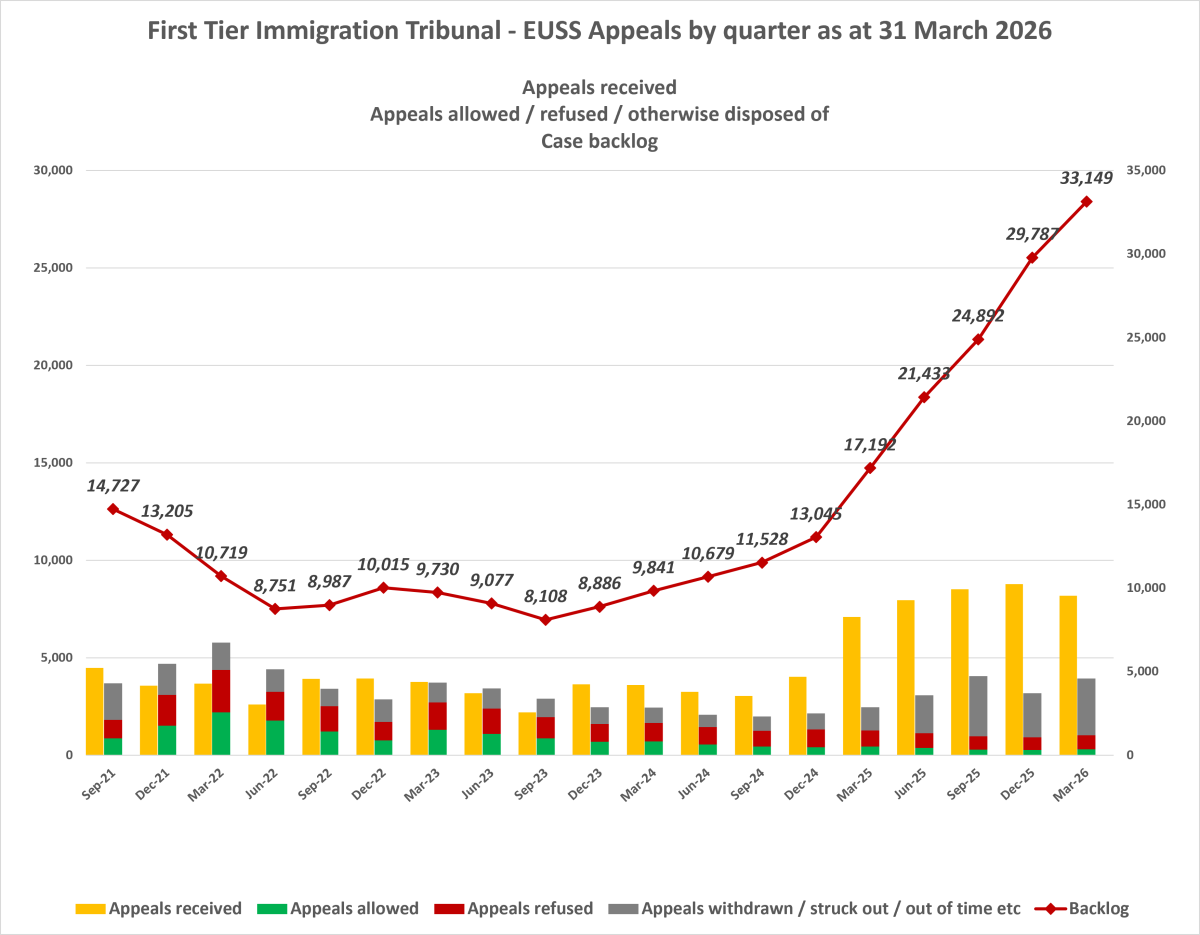
The courts see their own backlog of EUSS appeals however, which continues to increase at an alarming rate. At the end of March 2026, there were over 33,000 EUSS appeals in the tribunal backlog.
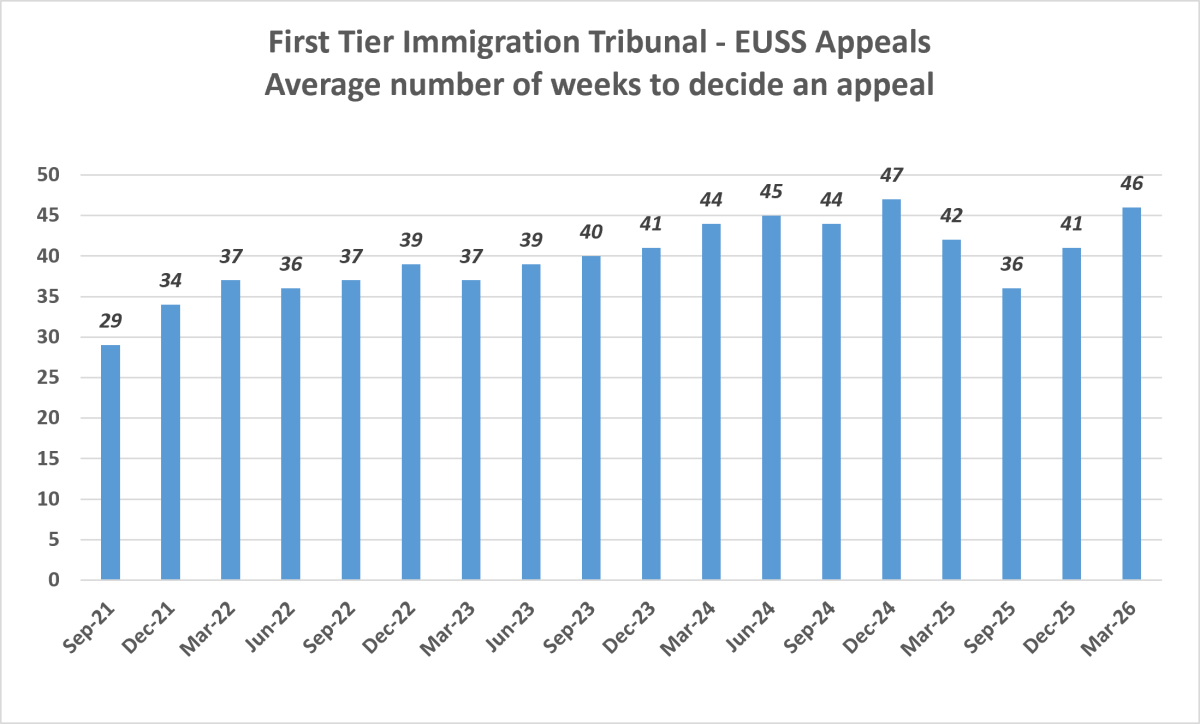
The statistics also show that for the cases that were decided at the First Tier Tribunal during the quarter ending March 2026, appellants had been waiting for their decisions for 46 weeks (over 10.5 months) on average.
The statistics show that since late 2023, each quarter a lot more appeals are received than are being dealt with by the courts - whether by deciding the appeal, or otherwise disposing of it (striking it out, ruling it out of time, the appeal being withdrawn etc.).
This has led to the very sharp increase in the appeals backlog - quadrupling from 8,000 to 33,000 in just 2.5 years.
- How many family members are applying for EUSS Family Permits?
Family members of EU citizens can either apply for an EUSS Family Permit before they come to the UK, and then submit an application to the EU Settlement Scheme once they are in the UK; or they can apply directly to the EU Settlement Scheme from abroad, if they are eligible to do so.
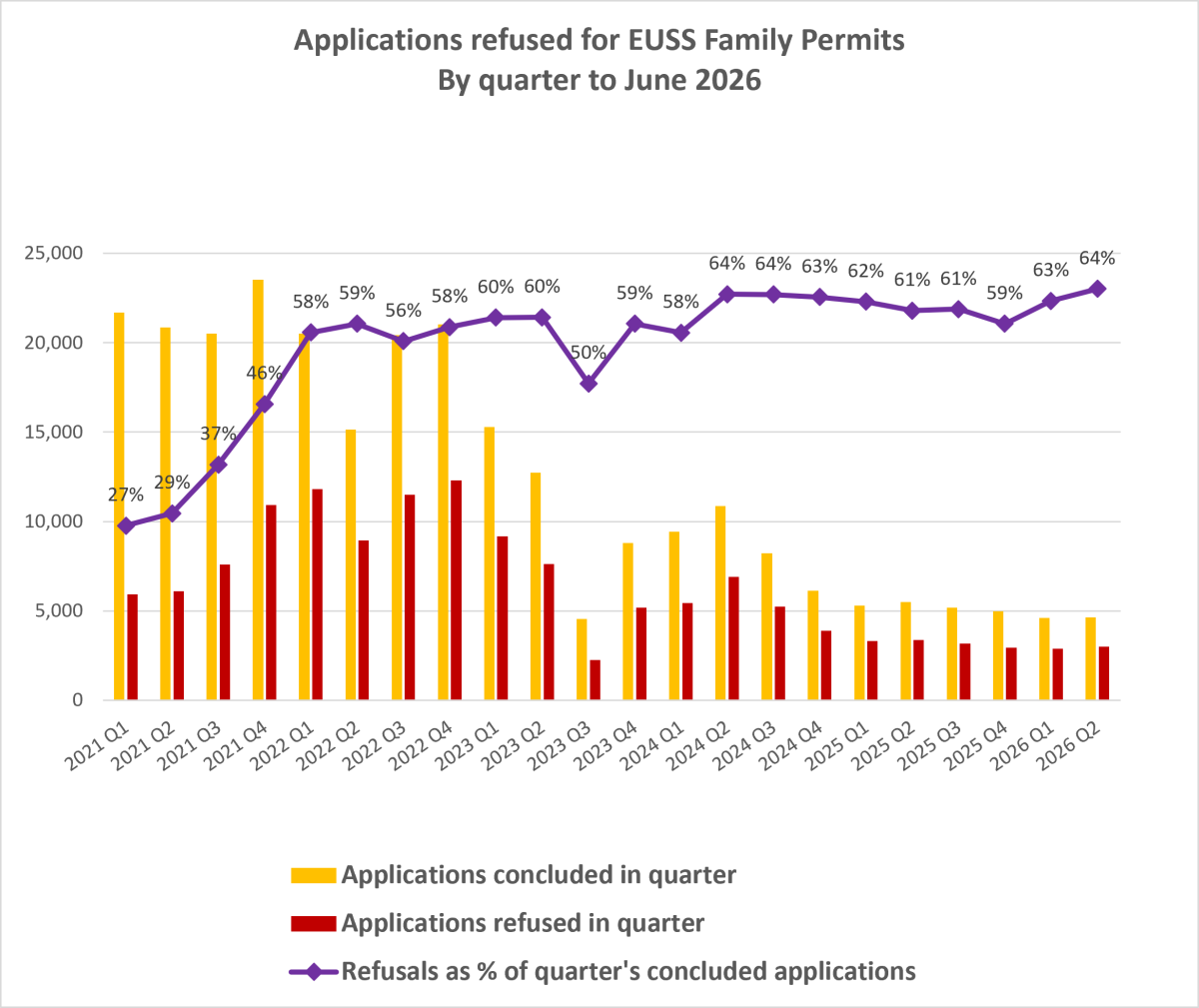
Consistently, over 60% of EUSS Family Permit decisions are resulting in a refusal.
Since 2022, an average of 60% of EUSS Family Permit decisions have been a refusal.
- How long does it take for EUSS Family Permits to be issued?
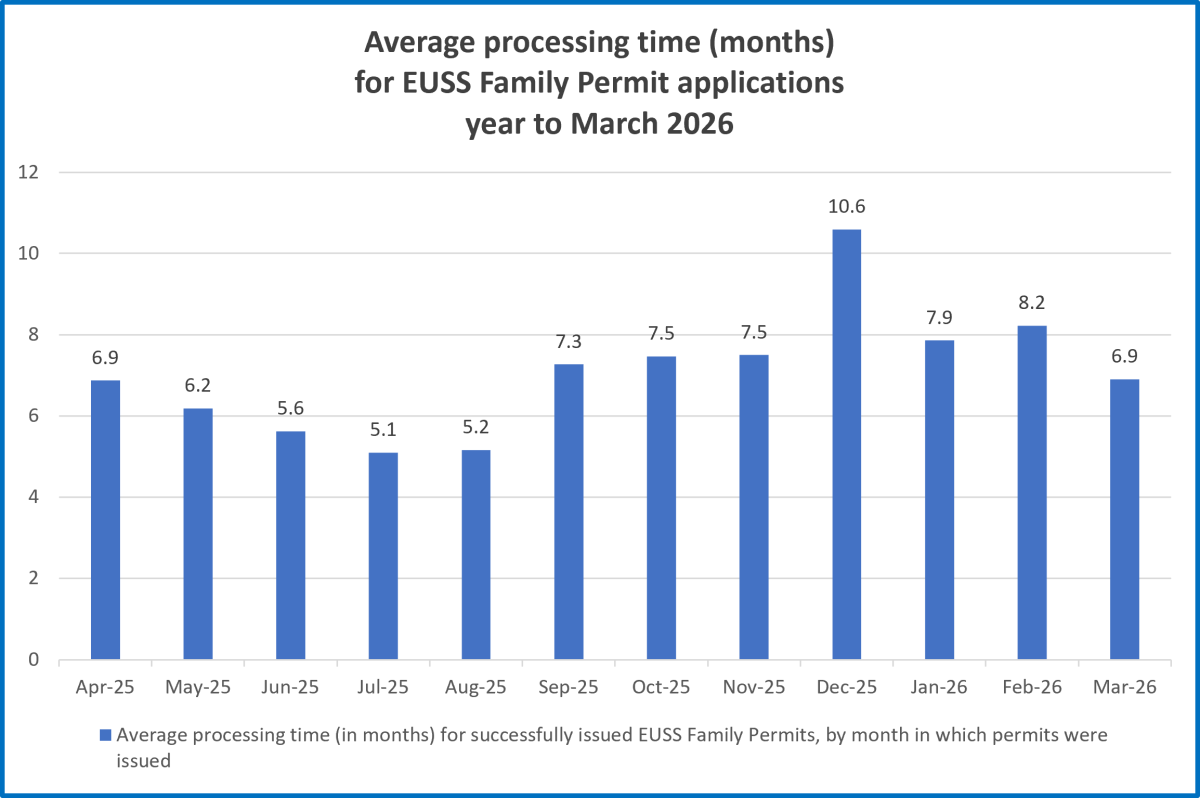
Despite application numbers remaining relatively steady since September 2021, the rate at which Family Permits are issued has been declining. Families are split apart for months on end, without any expectation management. Family Permits are the only visas which the Home Office does not set an expected time frame to be issued, and instead say they will be processed “as soon as possible”.
People who received Family Permits in March 2026 had been waiting for almost 6 months - this is a decrease from even longer waiting months over the past year. This type of entry visa is valid for 6 months, during which people can travel to the UK.
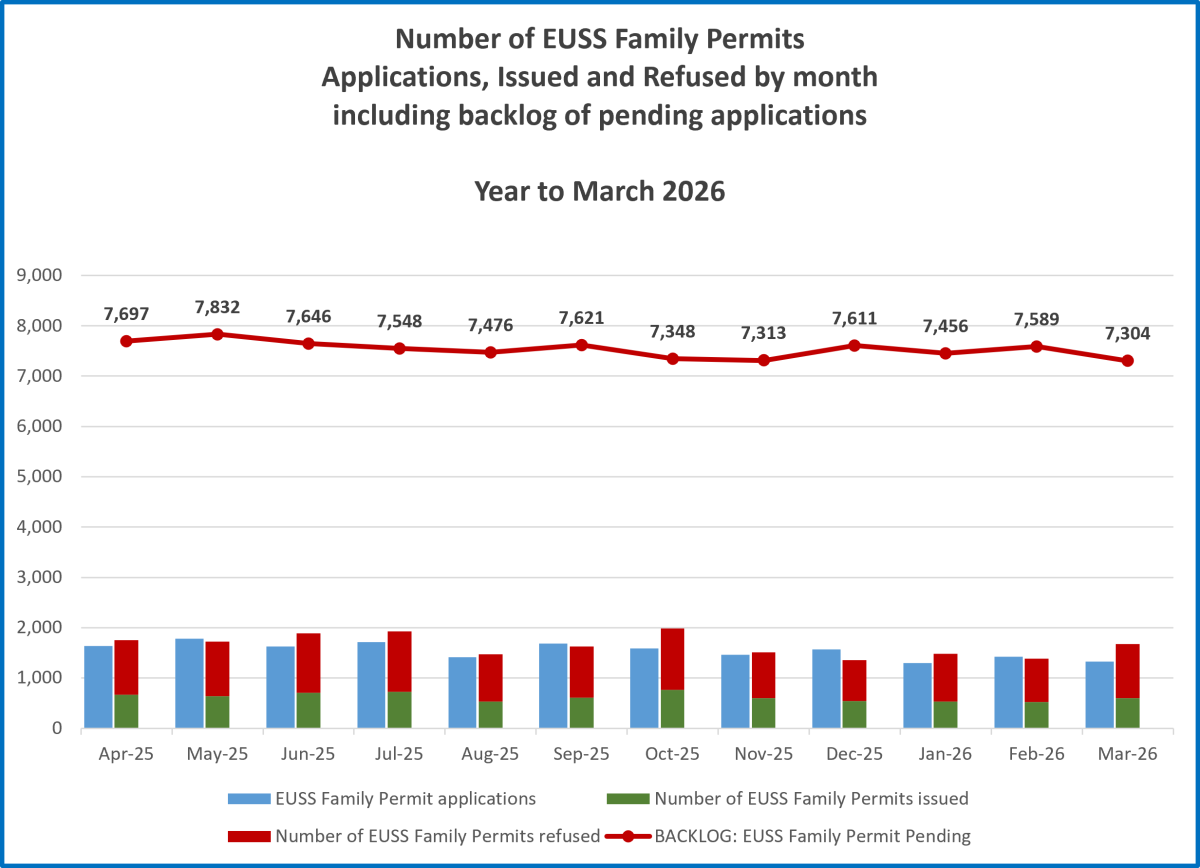
The backlog of unprocessed EUSS Family Permits has not fallen below 7,300 over the last year. As at March 2026, there is still a queue of over 7,304 people waiting for a Family Permit. Once they are in the UK, they need to put in an application to the EU Settlement Scheme, joining their second queue.
This often leads to people being uncertain of their immigration status for extended periods of time, facing hostile employers, landlords and banks, and having difficulties travelling.
- How many EU citizens were refused entry at the UK border?
The statistics show an enormous increase in number of EU citizens refused entry at the UK border since the transition period ended in December 2020. It shows the Home Office continues to subject people to a hostile environment where the burden of proof is always on the individual to prove their rights. After Brexit, EU citizens are now also treated with suspicion. We are getting more frequent reports of people being stopped at the border and questioned. The EU Settlement Scheme: Border Force guidance describes grounds for cancellation of leave.
This is a consequence of removing free movement between the UK and the EU - it’s the same treatment non-EU citizens have always been receiving. Although EU citizens can come to the UK for 6 months as visitors, people who intend to live and work here are questioned at the border and must be able to prove their immigration status.
Whereas before COVID, the number of EU citizens refused entry was generally below 1,000 per quarter, this is now typically around 3,000 per quarter. When looking at EU citizens refused entry as a percentage of all people refused entry, this has also strongly increased and is now around 50%-60%.
Considering just the last published quarter, April-June 2026, out of the 5,017 passengers refused entry at the border and returned, the top 10 nationalities are as follows:
- Romania - 872
- Brazil - 535
- Netherlands - 412
- France - 332
- United States - 249
- Belgium - 247
- Sudan - 207
- Bulgaria - 195
- Poland - 164
- Germany - 158
- Other Nationalities - 1,646
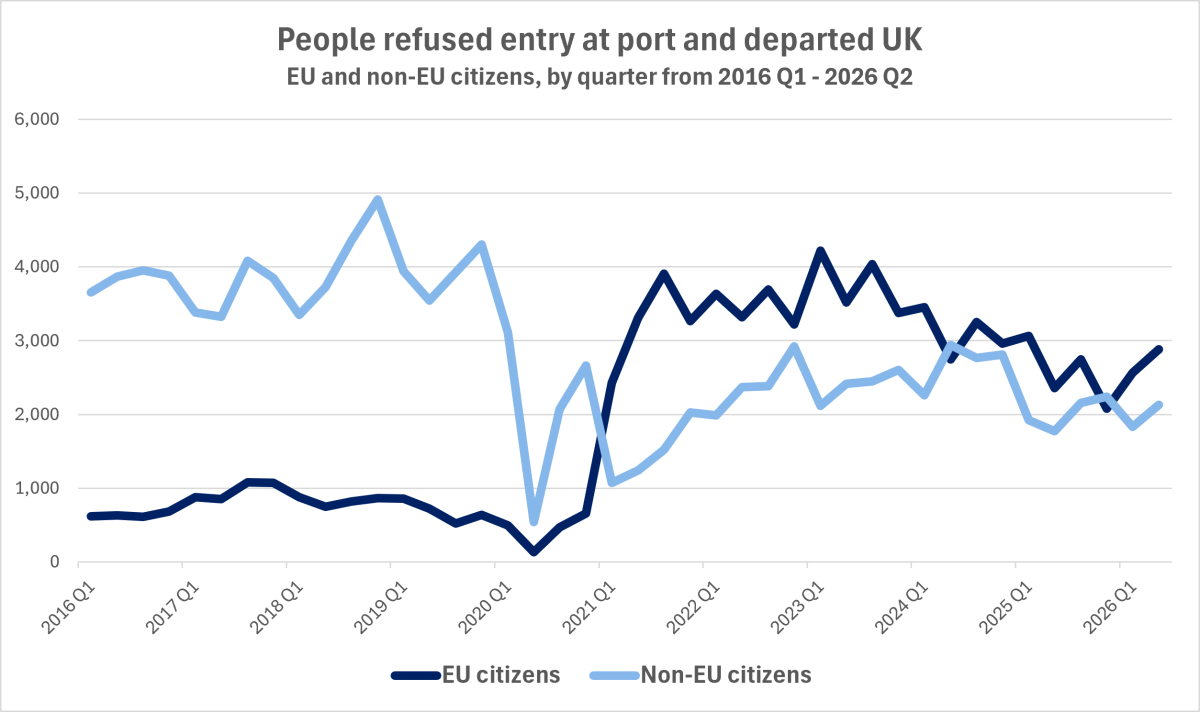
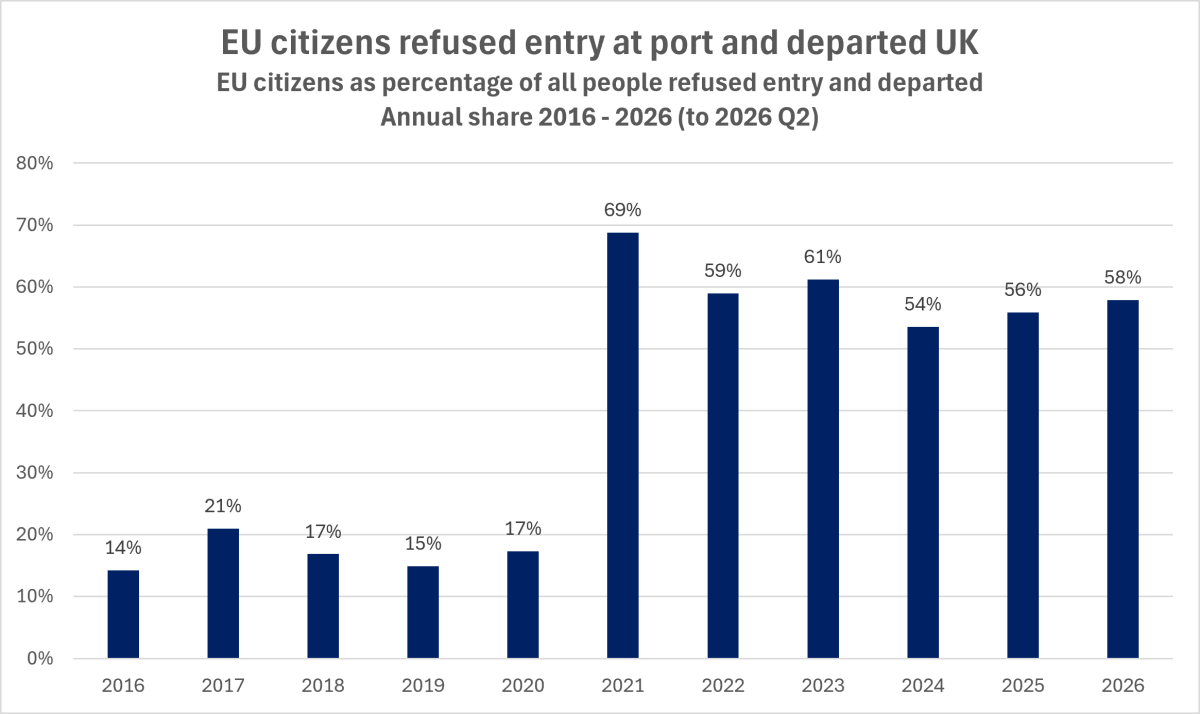
Source: Immigration statistics, June 2026, Returns dataset, Refusals of entry at port and subsequent return
- How many EU citizens were held in detention?
The Home Office publishes statistics on the number of people entering detention, held in detention at any given time, and leaving detention, broken down by the circumstance under which they leave.
The statistics categorise leaving detention into one of five reasons:
- Granted bail by an immigration judge
- Granted bail by the Home Office
- Granted leave to remain / leave to enter
- Left the UK
- Other
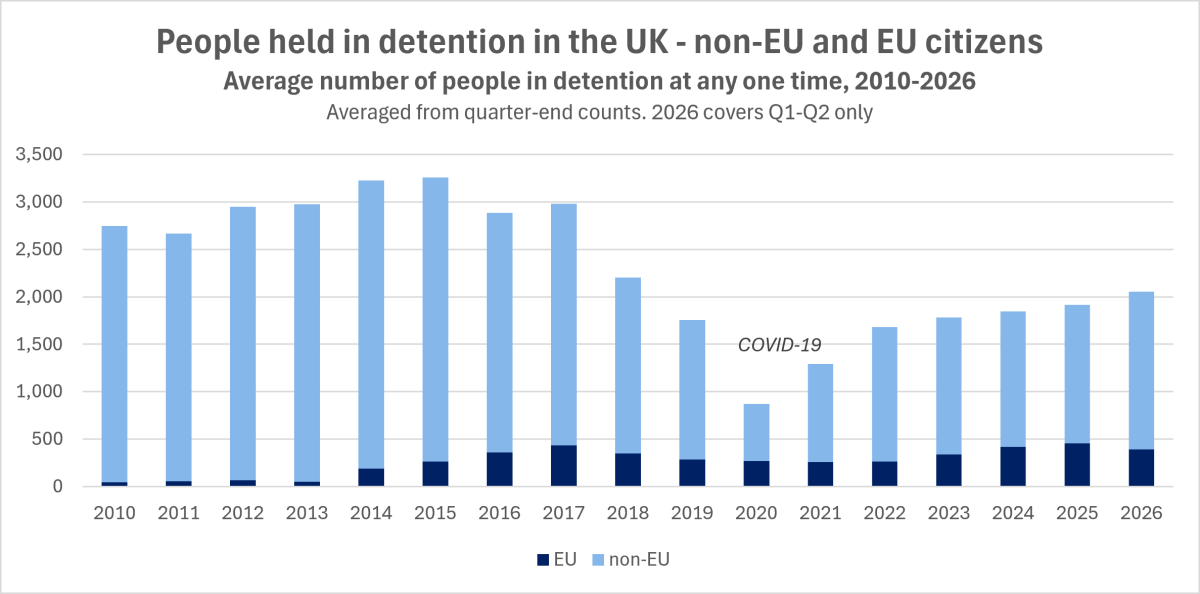
The chart below shows that around 2,000 people are held in detention at any one time.
Before 2013, around 2% of people held in detention were EU citizens. More recently, around 20% of people in detention are EU citizens.
The House of Commons library has a research briefing on immigration detention in the UK. The Charity Bail for Immigration Detainees (BiD) has an explainer on immigration detention.
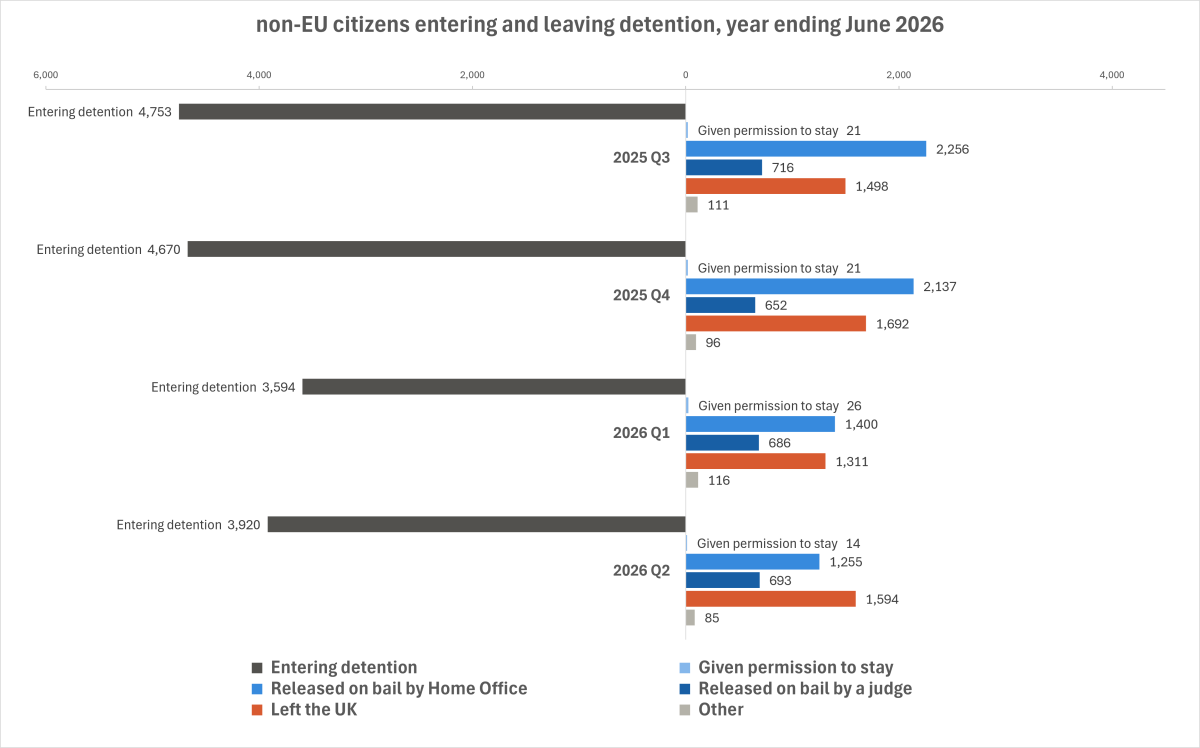
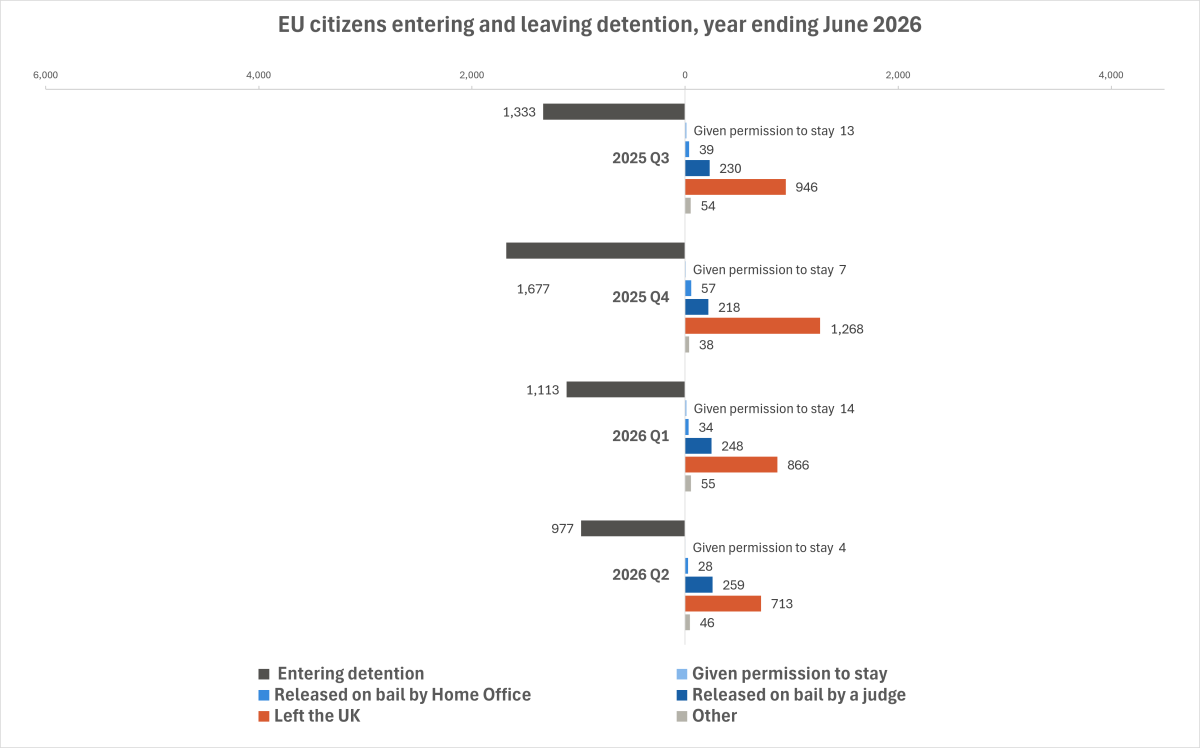
When looking at people who left detention by leaving the UK, it is clear that EU citizens are more likely to be removed from the UK after entering detention. Around 70% of EU citizens in detention leave detention by leaving the UK, compared to around 35% for non-EU citizens. This may be due to the variety of circumstances affecting people of different nationalities in their countries of origin, including human rights issues, cooperation with EU nations on providing emergency travel documents and the logistics of removing individuals. It is increasingly difficult for people who are detained to get legal advice - a BiD research report published in June 2026 found that access for people held in immigration detention has reached the lowest level ever recorded - only 27% of respondents had a lawyer, and 87% were aware of free legal advice but struggled to access it.
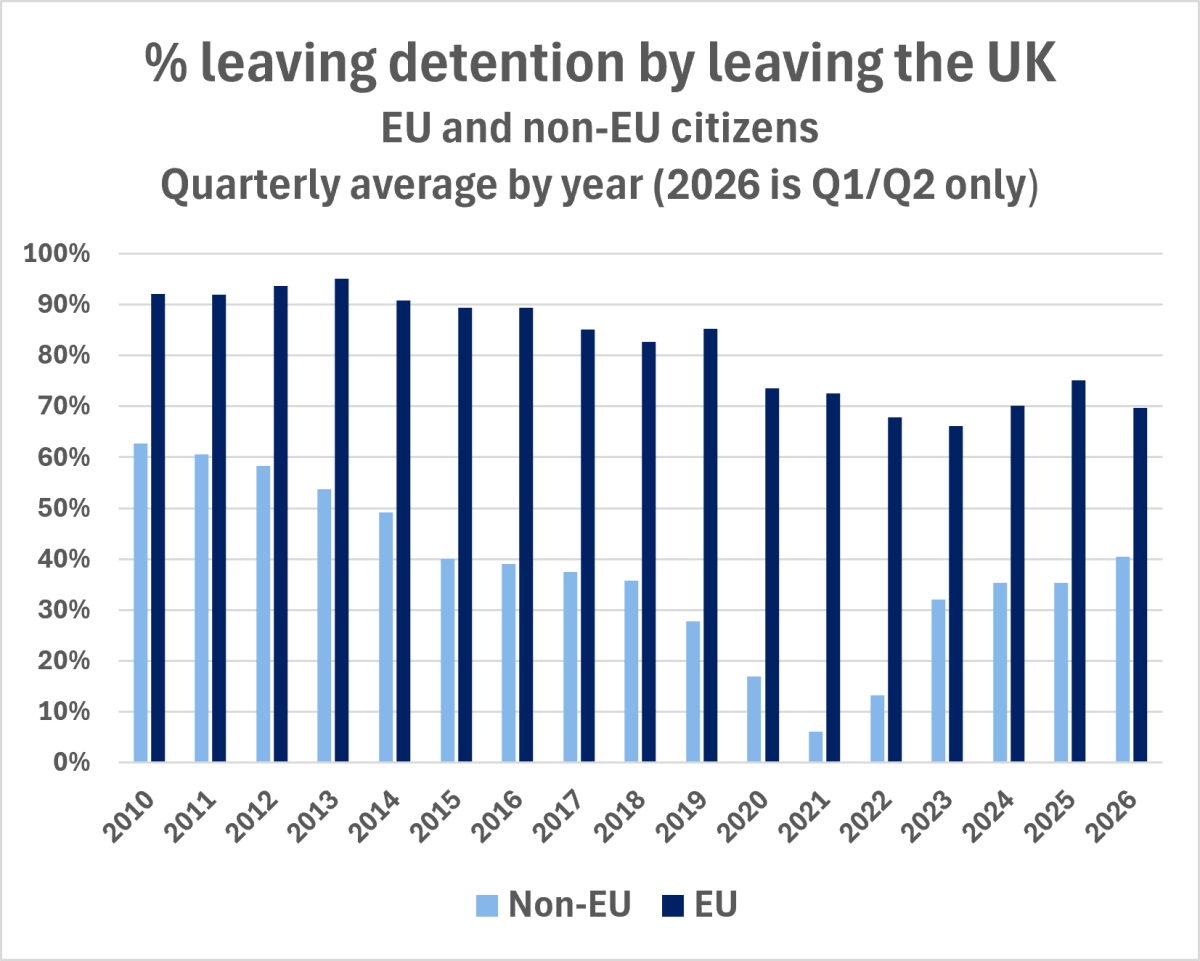
When considering only the most recent quarter (2026 Q2), 713 EU citizens left detention by leaving the UK against 1,549 non-EU citizens. Considering the 713 EU citizens who left the UK, their nationalities were as follows:
- Romania - 258
- Poland- 115
- Lithuania - 70
- Bulgaria - 54
- Portugal - 35
- Other - 181
The following two charts give more detail around the number of people entering and leaving detention for the year ending June 2026, for non-EU and EU citizens respectively.
- How many eVisa errors have been reported and corrected?
Many people experience errors using their eVisas - whether when:
- setting up initial access to their eVisa via a UKVI account that they need to create
- trying to use their eVisa to prove their status
- trying to update details on their eVisa, including linking a new identity document
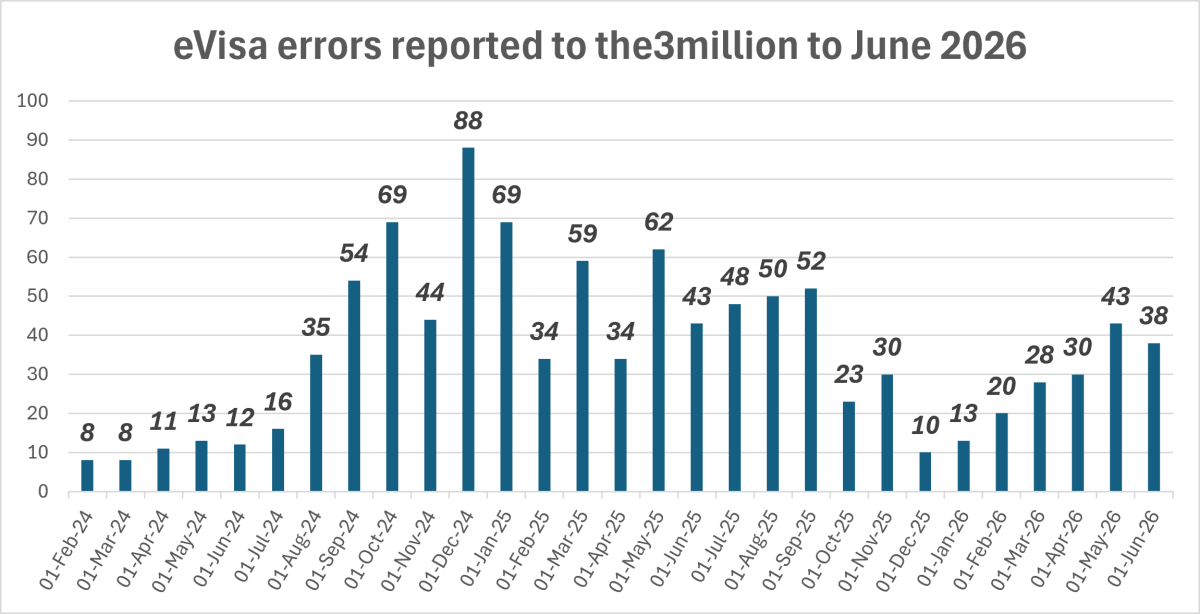
the3million provides a set of reporting forms on our Report It! website. Two of these reporting forms (problems with eVisas and problems travelling) are also hosted on a website eVisa problems that we set up together with the Immigration Law Practitioners' Association (ILPA).
The reports we see only represent the tip of the iceberg. This is because many people who experience problems will not have encountered our organisation, may not want to report their problem to us or may struggle with digital technology which would both contribute to their problems with eVisas in the first place and explain why they are unlikely to report to us.
Nevertheless, the reports we receive are highly valuable to us, as they give us early warning signs of issues that may be systemic, i.e. not just affecting one individual because someone made a mistake, but potentially affecting many people in similar circumstances.
We publish a quarterly analysis of the reports we receive - both on the eVisa problems website and on the Publications page of our website.
People can get help from the Home Office when they encounter problems, in one of several ways:
- Filling in a Home Office reporting form
- Using the eVisa webchat
- Contacting UKVI by telephone
- Watching eVisa support videos
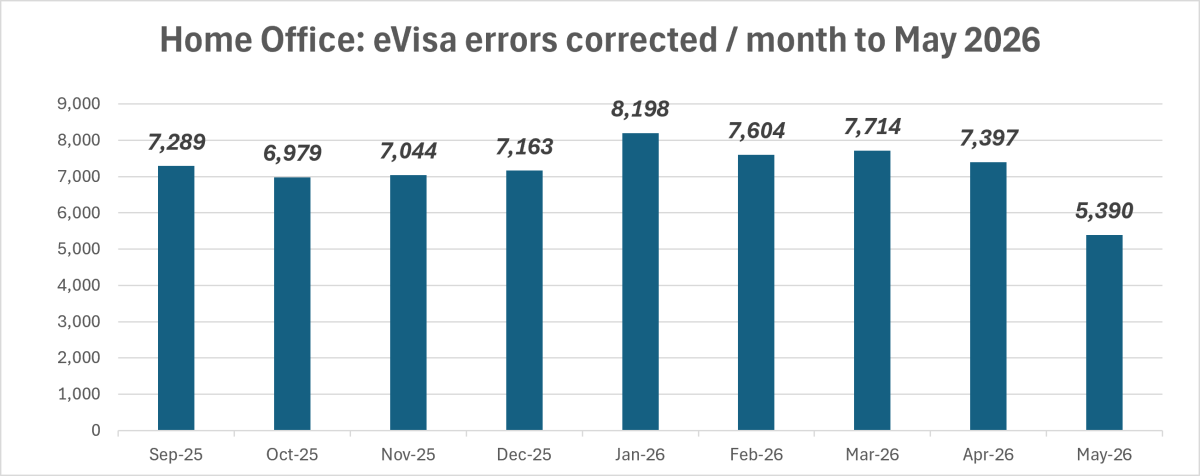
Following sustained requests for the Home Office to publish statistics on the errors reported to them, a section “eVisa error correction volumes from the online webform” was added to the eVisa account creation statistics on 1 July 2026.
This shows the number of errors corrected each month between September 2025 and May 2026. Note that this does not capture the number of errors reported to the Home Office, only those that were corrected.