10. Launch an inquiry into current digital status implementation alongside stakeholder consultation to explore alternatives
Two years on - fixed yet? NoThe Government has not launched an inquiry into digital immigration status, but two Parliamentary committees have now raised serious concerns about it. ❌ Not done: No public inquiry has been launched into how digital status has been introduced and the problems it has caused. ❌ Not done: There has been no consultation with organisations like ours on alternatives that would give people a secure proof of status they control, such as our proposal. ⚠️ Some progress: When the Government proposed a mandatory digital ID (since dropped), we submitted evidence to several Parliamentary committees.
|
Download policy paper
What?
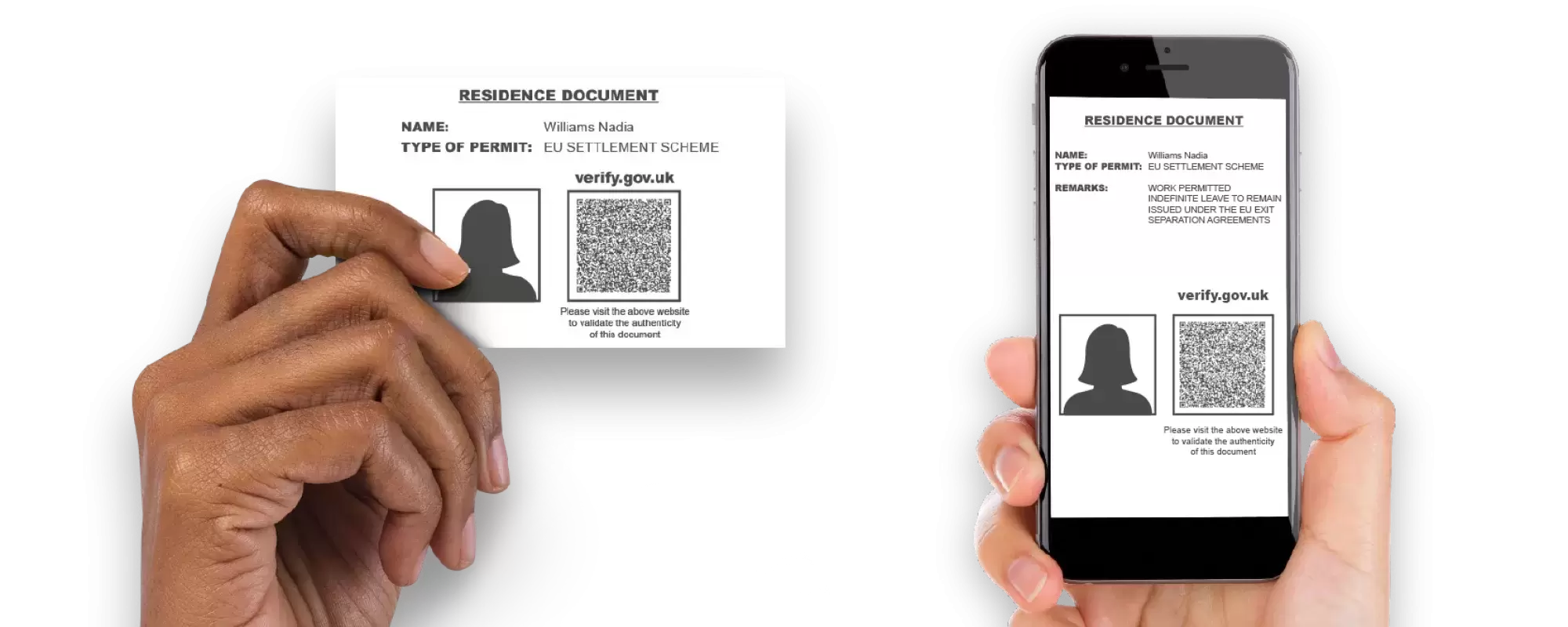
Digital-only status was first issued to the millions of EU citizens applying to the EU Settlement Scheme, and is now rolling out to all migration routes, with the aim of UK migrants having digital-only status by the end of 2024. The current implementation does not give the status holder a proof of status which is under their control. They do not have for example a digital document secured by QR code technology akin to a Covid Pass that they can show from their phones or even print out as a backup especially when travelling.
Instead there is a need to repeatedly engage with an online-only process, logging onto a GOV.UK website with two-factor authentication to receive a 9-character share code which must then be given to whoever is seeking to check their status to input into a different GOV.UK website before status is displayed. This system is not fit for purpose. It is inaccessible to many, and recent media reports have shown that the underlying Home Office data systems are seriously compromised.
A public inquiry should be launched into the impacts caused by the prior government’s introduction of the current system which became a barrier to accessing rights in July 2021. A stakeholder consultation process must be urgently set up to look into alternative implementations that give the status holder a secure, cost-effective proof of status that is accessible at all times. There are existing proposals ready to be explored.
Why?
Improving EU-UK relationship
Although the EU-UK Withdrawal Agreement allows for a digital document, questions have been raised at the Specialised Committee over the UK’s current implementation of digital status. See statements of 24 January 2022, 15 June 2022, 25 May 2023, 4 December 2023.
Impacted citizens
Vulnerable and digitally-excluded people are seriously impacted by this implementation. For some, the two-factor authentication code is sent to whoever helped them apply for the status several years ago, rendering the proof of status inaccessible. In many situations, a lack of WiFi or broadband signal leaves proof of status out of reach. For tens, possibly hundreds of thousands, their records on the Home Office database have been compromised leading to errors when trying to view or prove their status.
Why not? Reasoning behind UK Govt position and why we disagree
The Home Office has rejected alternative proposals (based on secure QR code technology as used in the Covid Pass app) because they are “committed to a digital system of real-time checks, and we will not compromise on this principle.” In direct contrast, we assert that there is a need for a digital system which is not real-time, until it is the case that the Home Office status databases are always available, 24/7, no-one’s digital records are broken, and everyone including the most vulnerable has access to technology, internet and digital know-how.
The cost of real-time checks is currently being paid by thousands of people who have rights but are unable to demonstrate them - just as happened in the Windrush scandal. In any case, the principle of real-time checks is entirely unnecessary and illusory even on its own terms. An employer for example can check someone’s status on day one, and will not need to re-check that status for a considerable length of time - during which it could be revoked. So whether the employer check on day one is a real-time one, or a check based on an alternative offline implementation which may have a very short lag in showing revocations, is entirely immaterial.
Cost?
We would anticipate an inquiry into current digital status implementation to be at the lower end of the range of public inquiry costs.
The cost of developing an alternative implementation of digital status can be estimated by considering the cost of developing the Covid Pass, which has similar functional and technical requirements. The Covid Pass was developed in house by DHSC and DHSC Arm’s Length Bodies for £25 million.
How?
Primary legislationSecondary legislationImmigration RulesGuidance change
The detail
Set up a public inquiry into the:
- development of the current digital proof of status, initially based on a 2018 right to work beta trial and now being rolled out to all migrants resident in the UK;
- security and integrity of Home Office databases underpinning digital proof of status;
- efficacy of Home Office support services for digital status, including the UKVI Contact Centre and the EU Settlement Resolution Centre;
- scale and depth of impacts faced by individuals unable to prove their status and thereby denied their right to work, rent, study, travel, access benefits and healthcare and more;
- lack of stakeholder or parliamentary consultation before imposing the current digital proof of status on a cohort of several million EUSS status holders;
- validity of the Home Office ‘exclusion of liability’ on UKVI accounts;
- Equality Act implications of the current proof of digital status.
Details of the alternative proposal of digital status implementation as proposed by the3million:
- ‘Our proposal for fixing the digital status’ available at the3million.org.uk/our-proposal-fixing-digital-status.