9. Protect legacy ILR holders by ensuring continuing validity of their documents while providing option of BRP/eVisa without status review
Two years on - fixed yet? PartlyPeople with older documents proving indefinite leave to remain (ILR) are better protected than we feared, and getting an eVisa has become simpler, but travel checks are now fully in force. ✅ Done: Older ILR documents are still valid for proving immigration status in the UK. They can no longer be used for right to work checks, but that has been the case for many years. ✅ Done: Airlines and other carriers must still accept ILR documents in expired passports. ❌ Not done: Universal permission to travel was not paused, and has been fully enforced since September 2026. ⚠️ Partly: After we and others raised concerns, the Home Office simplified the No Time Limit (NTL) application in autumn 2024. This is how people with older ILR documents get their status recorded on a new document or eVisa. Instead of proving decades of continuous residence, people can now generally make a declaration that they have not been outside the UK for more than two years in a row. |
Download policy paper
What?
The Home Office is requiring all UK residents with physical proof of immigration status to transfer to a digital eVisa. Those with biometric residence permits are invited to set up a UKVI account in order to link to their eVisa, which is an administrative process.
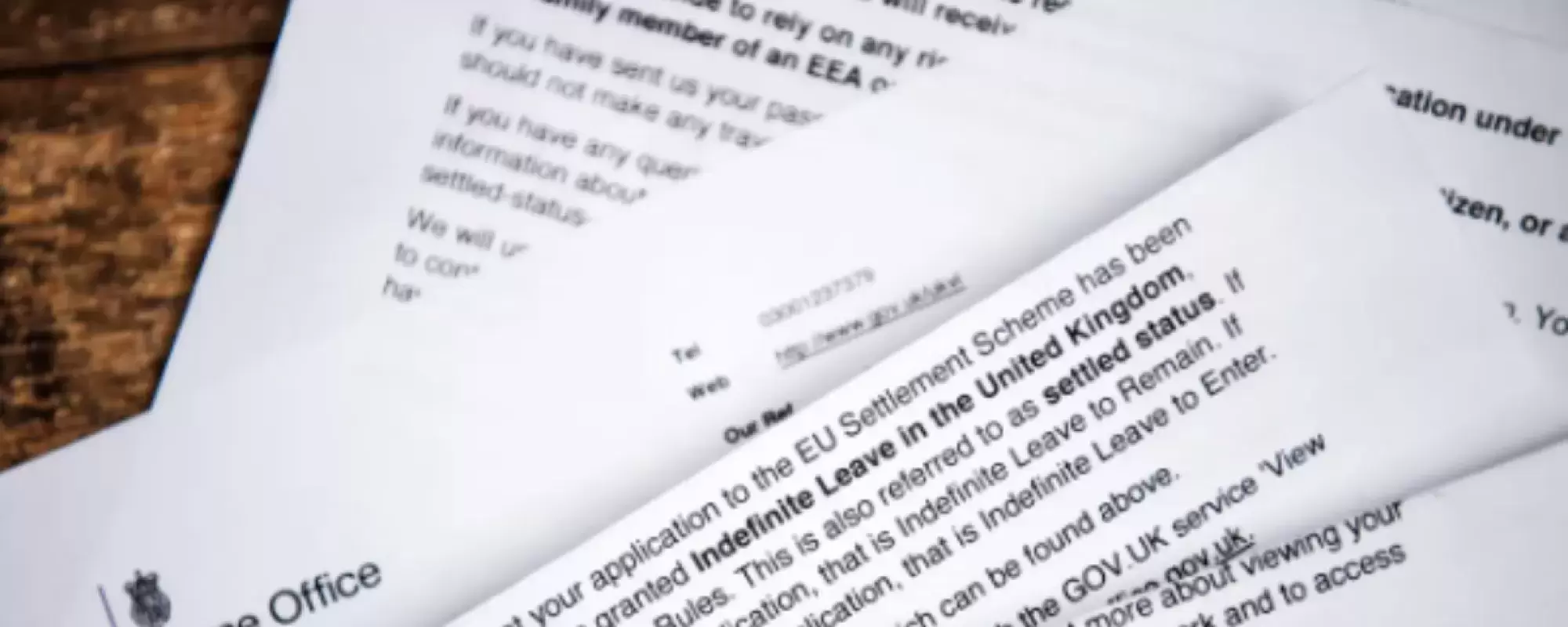
However, indefinite leave to remain (ILR) holders with legacy documentation - for example stamps / vignette stickers in passports or old letters from the Home Office - are required to make a ‘no time limit’ (NTL) application to the Home Office before they can obtain an eVisa. These applications are onerous, requiring evidence of continuing residence in the UK since the grant of their ILR.
We propose that firstly, this legacy documentation must remain valid for proving immigration status within the UK. Secondly, the Government must pause its implementation of the ‘Universal Permission to Travel’ scheme, and maintain its current policy of only checking documentation for non-visa nationals at the UK border. The alternative is to mandate all carriers to accept legacy ILR documents as proof of UK immigration status. For those who do want to transition to an eVisa, we propose a straightforward swap of legacy documentation, without an application process or status review.
Why?
ILR holders with legacy documentation form the UK’s oldest migrant population. NTL applications typically require the submission of decades of evidence of UK residence, which many will be unable to provide. Women, the elderly, those lacking digital literacy and other vulnerable citizens will be disproportionately affected.
It is unjustifiable and potentially discriminatory that this cohort is subjected to a review of their status by way of an NTL application. These people will very typically have kept hold of their old documents precisely because of struggling with technology or engaging with the Home Office. It is not their fault or choice that the Home Office is moving with speed towards a digital-only status, yet they are now being mandated to undergo an onerous process with severe risk of refusal and becoming undocumented through lack of sufficient historical evidence of UK residence.
To date, non-visa nationals with legacy documentation have been able to travel out of and back to the UK, because their legacy documentation is accepted at the UK border. However, if these individuals do not apply for an eVisa, as it stands they will be unable to travel and return to the UK once the UK implements its ‘Universal Permission to Travel’ (UPT) scheme. This is because UPT is aimed at ‘pushing the border upstream’ and preventing anyone from boarding if they are unable to prove their immigration status to their carrier. The system delivering this proof is ‘interactive Advance Passenger Information’ (iAPI) and requires an eVisa. UPT is timetabled to commence as soon as the Electronic Travel Authorisation (ETA) scheme is fully rolled out, in 2025.
Why not? Reasoning behind UK Govt position and why we disagree
We are unsure why the Home Office is unwilling to waive NTL applications for those with legacy ILR documentation, in the context of the eVisa deadline of 31 December 2024. We would consider that it would be in the Home Office’s own interests to do so, since it will save considerable case working resources.
Cost?
NTL applications are free, so there is no opportunity cost in not requiring this cohort to submit an NTL application. We believe that this will only be a cost-saving to the Home Office through the savings in case working.
How?
Primary legislationSecondary legislationImmigration Rules- Guidance change
The detail
All immigration status checkers within the UK, for example the NHS, must be instructed to continue accepting legacy documentation.
Carriers must be instructed to continue allowing non-visa nationals to travel to the UK without checking their immigration status. Effectively, this is a pause to the rollout and full implementation of Electronic Travel Authorisation (ETA) and Universal Permission to Travel (UPT) schemes. In the alternative, carriers must be instructed to accept legacy ILR documentation when doing UPT checks for non-visa nationals.
Allowing for a straightforward swap of legacy documentation for a BRC and eVisa only requires a policy change, which is to not require anyone with legacy ILR documentation to submit a ‘no time limit’ NTL application. Instead the Home Office must allow those with legacy documentation to set up a UKVI account, and in turn gain access to an eVisa, only by supplying their legacy documentation and making a statement of truth that they are currently residing in the UK or have not lost their ILR since they were last in the UK.