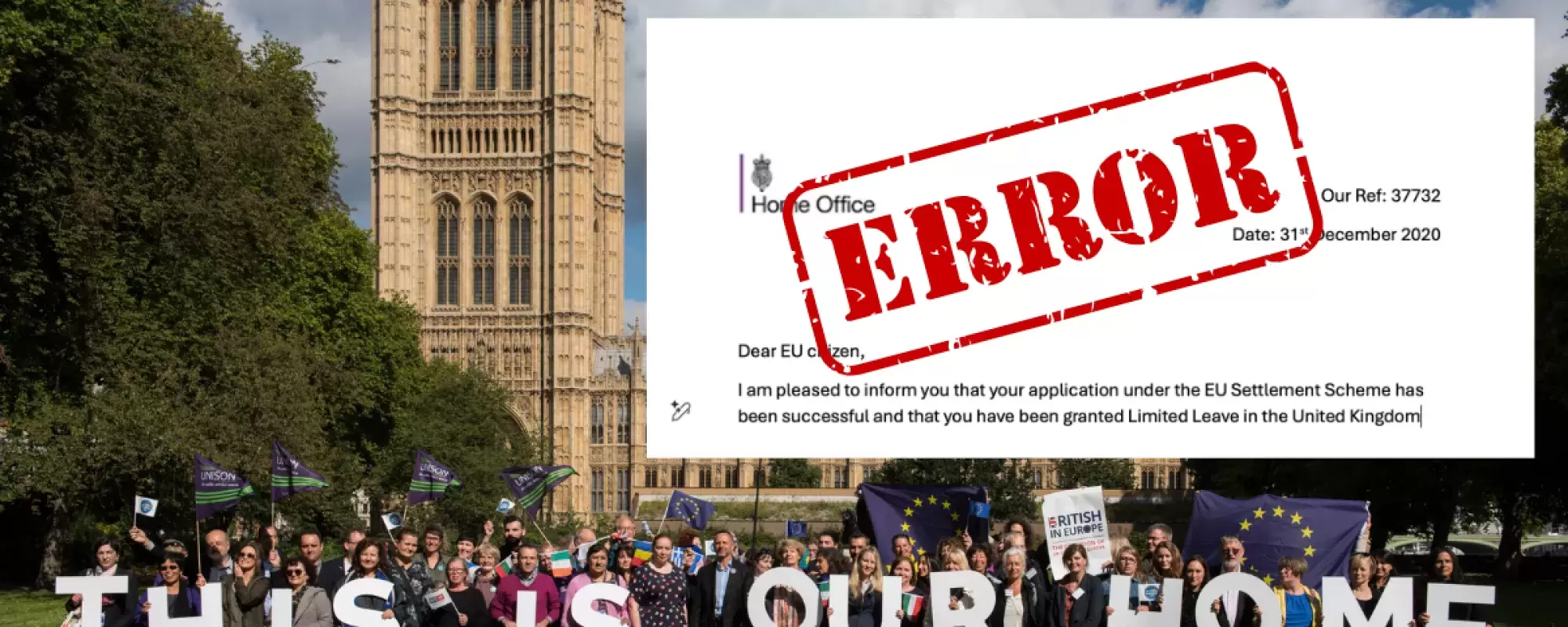
What to do if the Home Office says your EUSS status was granted in error
How many people have been told their status was granted in error?
We don’t know exactly, but on 24 September 2026, a Home Office minister said in response to a parliamentary question by Lord German that up to 30 June 2026, 1,473 individuals had been notified that their pre-settled status was granted in error.
Is the Home Office ever wrong to say your status was granted in error?
the3million believes that yes, in many cases the Home Office was wrong to say that someone’s status was granted in error. This is one of the reasons we have launched a legal challenge to the ‘Granted in error’ policy, as we do not agree with the way in which such cases are being dealt with by the Home Office.
Below, we explain the most common scenarios where we have seen that the Home Office is wrong to say status was previously granted in error.
- Dual nationals who had Italian citizenship from birth
the3million has heard from many people, many of whom were born in Brazil with a birthright entitlement to Italian citizenship. These people told us that they were living in the UK before the EU Settlement Scheme cut-off date of 31 December 2020, and they had started the process of obtaining proof of their Italian citizenship through a process called jure sanguinis. However, partly due to lengthy delays caused by the COVID pandemic at the time, they only received the confirmation of their Italian citizenship from birth, together with their Italian passport or identity card, after December 2020.
They then proceeded to apply for, and be granted, pre-settled status, as the Home Office were happy to accept that they were Italian citizens before the cut-off date.
However, when these same people more recently applied to upgrade their pre-settled status to settled status, the Home Office said their pre-settled status was granted in error on the basis they were not in fact Italian citizens (therefore not EU citizens) by the 31 December 2020 cut off date. The consequence of this was that their settled status application was refused, and their pre-settled status would be allowed to expire. Read Giovanni’s story to see how this has impacted one such person caught up in this.
In October 2026, the Home Office has accepted that where a person provides evidence of their Italian citizenship, together with evidence that this was obtained through jure sanguinis, they will now accept that this person was an Italian from birth. The Home Office is now reviewing all the decisions where they said status had been granted in error. If this impacts you, please report it to us, using our Losing EUSS Status or Rights reporting form.
- Durable partners who did not have a ‘relevant document’ under the EEA Regulations
EU citizens who were living in the UK by 31 December 2020 are able to sponsor their spouse or civil partner under the EU settlement Scheme, as long as the marriage or civil partnership took place by 31 December 2020.
If they weren’t married or in a civil partnership, but had a ‘durable relationship’ (this means a serious relationship) by 31 December 2020, the EU Settlement Scheme also allows them to sponsor their ‘durable partner’. However, sponsoring a durable partner has some additional requirements:
- If the partner was also already living in the UK by 31 December 2020, they needed to have a ‘relevant document’ issued under the EEA Regulations to show that the Home Office had accepted their durable partnership. This document can take the form of an EEA Family Permit, and EEA Registration Certificate, EEA Residence Card, or a “letter from the Secretary or State, confirming your qualifying for such a document had the route not closed after 30 June 2021”. In some cases the UK courts have accepted alternative evidence as confirmation the partner fell under the EEA Regulations.
- HOWEVER, if the partner was living in the UK under some other UK visa or immigration permission, for example they were a student, or a skilled worker at the time, then they did NOT need this ‘relevant document’. This was confirmed in a letter to the3million on 15 February 2022. In such cases, the partner would be eligible for EUSS status despite not having the ‘relevant document’, but they would be granted pre-settled status as a ‘joining family member’ instead. In these cases the partner would become eligible for settled status five years after the grant of pre-settled status.
- ALTERNATIVELY, if the partner was living in the UK by 31 December 2020, but they didn’t have a ‘relevant document’, and they also didn’t have a different UK visa or immigration permission, then there was still another way of becoming eligible for pre-settled status. This however involves leaving the UK for 6 months to break continuity of residence, applying for an EUSS Family Permit to come back to the UK and apply for a fresh grant of pre-settled status.
The way the above is set out in Appendix EU is very complex. Even many immigration lawyers can struggle with the details. In fact, there is an Upper Tribunal case from where Judge Canavan said in her January 2023 judgment:
“Having spent many hours considering this part of the rules one finds that there is nothing natural or plain about the wording that might reveal its intended meaning. A repeated reading of paragraph (aaa), the associated definitions within the Appendix, and the policy guidance only leads to a 'curiouser and curiouser' situation. Like Alice in Wonderland one falls down a rabbit hole and stumbles across a circular race, with the Eaglet exclaiming: 'Speak English!... I don't know the meaning of half of those long words, and what's more, I don't believe you do either!'.”
We have now seen many cases where EUSS caseworkers don’t understand the rules properly either, and are telling durable partners that their previous grant of pre-settled status was granted in error.
If you are a durable partner, and you have been told your pre-settled status was granted in error, please report it to us, using our Losing EUSS Status or Rights reporting form.
How can you protect your rights if you disagree that the Home Office said your status was granted in error?
On 24 September 2026, a Home Office minister said in response to a parliamentary question by Lord German that:
“A person informed by the Home Office that they have been granted pre-settled status in error can re-apply to the EUSS if they disagree and, if refused, they can appeal to the independent First-tier Tribunal (Immigration and Asylum Chamber). Where such an application to the EUSS is made before the expiry of their pre-settled status, they will continue to hold that status while the application, and any appeal against refusal, remains outstanding.”
However, we’re hearing from people who are in exactly the position described by the minister above who cannot prove their continuing rights at all. Their eVisa shows their pre-settled status is expired, they cannot produce a share code and face all the risks of the ‘hostile environment’. They cannot prove their right to work, to rent (in England), to enter the UK, to welfare or healthcare and much more. They are at risk of losing their existing job, home or benefits.
We are also not clear by what mechanism everyone is legally protected where they have reapplied to the EUSS before the expiry of their pre-settled status, especially if the refusal comes before the pre-settled status expires.
We have created an FAQ that contains some recommendations if your pre-settled status expiry date is coming up soon, and you think the Home Office is wrong to say it had been granted in error. See: When I applied to upgrade from pre-settled status to settled status, the application was refused, and I was told my pre-settled status was granted in error and wouldn’t be extended. My status expires next month. I appealed the refusal – will the appeal continue to protect my rights once my status expires?
You will see in that FAQ that we recommend you don’t travel out of the UK, because of the way ‘3C leave’ works (see this excellent explainer by Right to Remain - Section 3C leave: when your visa expires but your status continues).
However, we consider from the minister’s reply to the parliamentary question above that people should not have to rely on the ‘3C leave’ mechanism anyway, and that instead they should have their full Withdrawal Agreement rights while challenging the ‘grant in error’ finding, including the right to travel out of and back into the UK.
NOTE: For completeness, it is also possible to challenge the Home Office ‘grant in error’ finding through a judicial review (JR). However, a JR by itself does not provide protection of your rights if your pre-settled status expires. The rules say that a JR must be filed promptly and no later than three months from the date on which the granted in error decision was made. Prior to lodging a JR, it is important to factor in the time required for sending the Pre-Action Protocol (PAP) letter to the Home Office. You should usually give the Home Office 14 days to respond to your PAP letter. You will then need time after you have received the decision to lodge your JR claim with the court. In practice therefore, it is recommended to send the PAP letter as soon as possible, and within six weeks of the date of the Home Office decision not to extend pre-settled status.


