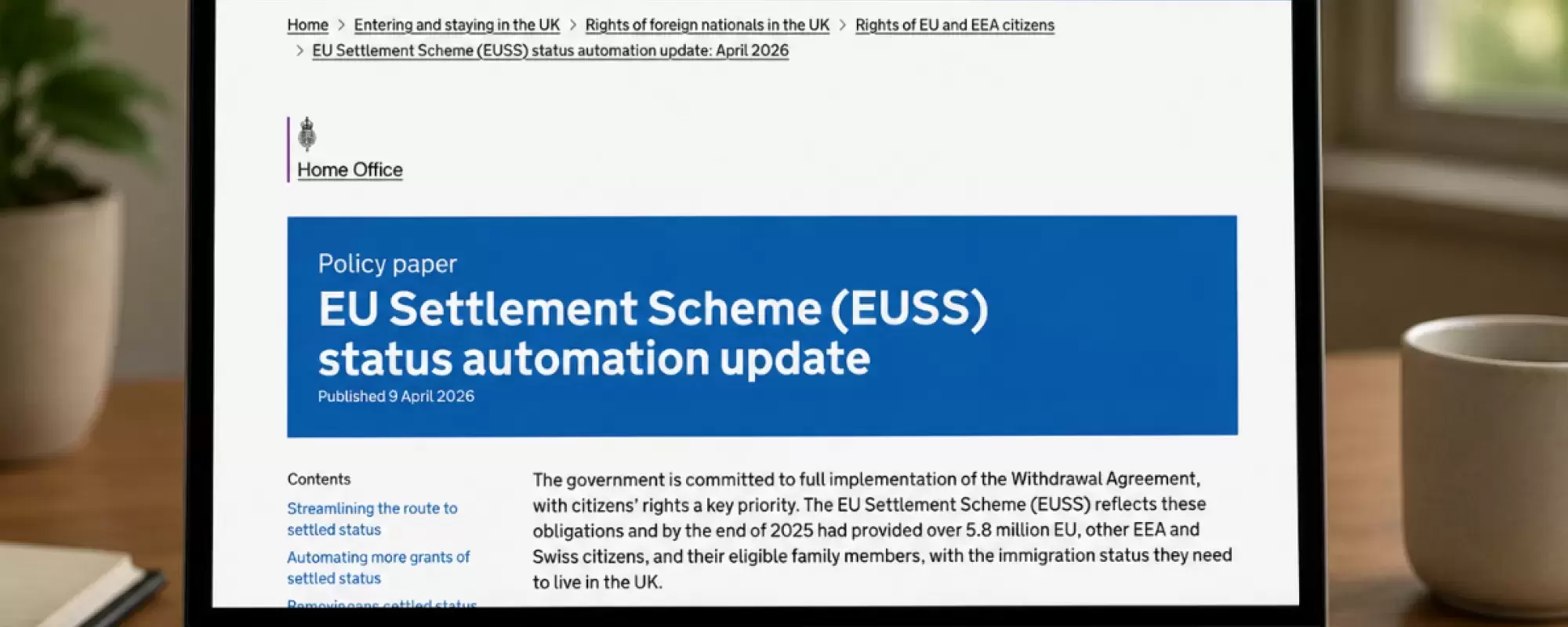
EUSS automation - extensions, upgrades and cancellation
If your pre-settled status is expiring soon, this page explains the current automation process, and what emails you can expect to receive from the Home Office.
- Background to euss automation
The EU Settlement Scheme (EUSS) was launched in late 2018. For those who were granted pre-settled status in the earliest days of the scheme, this meant that their pre-settled status would expire in late 2023.
A 2022 High Court judgment (brought by the IMA, with the3million and the European Commission intervening) decided that pre-settled status couldn’t simply expire just because the individual didn’t make a further application to the EUSS.
Therefore, to comply with this High Court judgment, the Home Office implemented various phases of what is referred to as "automation", to make sure pre-settled status did not expire, so that those who continued to meet the conditions of the Withdrawal Agreement would not unlawfully lose their status.
- Phase 1 automation
In September 2023, the Home Office started automatically extending people’s pre-settled status just before it was due to expire. These extensions were applied in a blanket fashion without the Home Office checking whether people were still meeting the conditions for pre-settled status (for example, pre-settled status who had left the UK permanently would still receive an extension)..
- Phase 2 automation
In January 2025, the Home Office started a process of automatically upgrading some pre-settled status holders to settled status. This was not required by the High Court judgment, but was done to try to move more pre-settled status holders who qualify to settled status.
The only pre-settled status holders who could benefit from the automated upgrades were those who:
- Were an EU/EEA/Swiss citizen; and
- had been in the UK by 31 December 2020; and
- were over 18; and
- had not been granted pre-settled status under one of the ‘derivative rights’ routes; and
- had not been granted another form of immigration status after having pre-settled status; and
- had a five year digital footprint with HMRC or DWP showing they have lived in the UK for at least 6 months in every 12 months for a continuous 5-year period.
This means that many pre-settled status holders who qualify for settled status (e.g. sponsored family members with five years' continuous residence) cannot be automatically upgraded and still need to make a 'manual' application to be granted settled status.
CURRENT ("Phase 3") automation
On 9 April 2026, the Home Office introduced phase 3 of their automation process, which has replaced phases 1 and 2. A welcome change in phase 3 is that the automation now uses the more flexible ‘30/60’ absence rules to determine eligibility for settled status, rather than the previous more restrictive ‘6/12’ absence rules (see our webpage on changes to the absence rules for more details).
However, as with phase 2, you can only be automatically upgraded to settled status if all the following are true:
- you are an EU/EEA/Swiss citizen; and
- you were in the UK by 31 December 2020; and
- you are over 18; and
- you have not been granted pre-settled status under one of the ‘derivative rights’ routes; and
- you have not been granted another form of immigration status after having pre-settled status; and
- you have a five year digital footprint with HMRC or DWP showing you have lived in the UK for at least 30 months out of the previous 60 months at the time the automation check is done.
See our webpage on automatic upgrades for more information. However, as explained in more detail below, in some cases travel data can also result in a semi-automated grant of settled status.
Phase 3 also brings in a new part of the process: the Home Office removing pre-settled status from people who they think have been out of the UK for too long, and have therefore broken their continuous residence.
Removing pre-settled status is legally known as “curtailment” or “cancellation”. This is why the Home Office sends out a “minded to curtail notice” to tell someone that they are considering removing their pre-settled status. The below references to curtailment or cancellation therefore mean removing pre-settled status.
On this page, we try to set out how phase 3 of the automation process will work in practice, and what the emails that you might receive from the Home Office will look like. Please make sure your contact details are up to date in your UKVI account so that you receive these emails.
* Please note, the content of these email templates were correct as at 4 June 2026, they are subject to change by the Home Office.
- Receive initial automation email
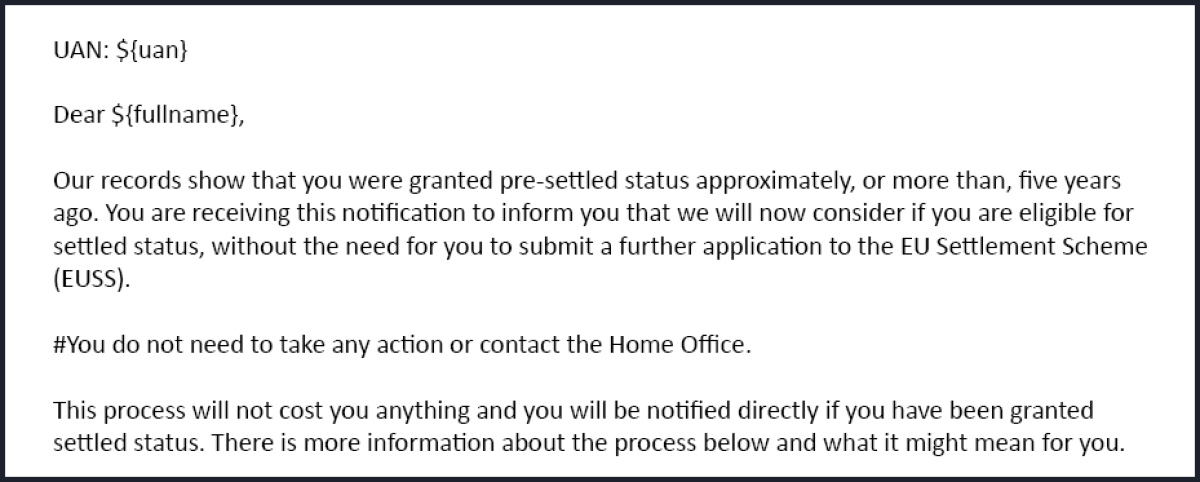
If you have pre-settled status, then at some point before it is due to expire, you should receive the email below from the Home Office.
You don’t need to do anything at this point, it’s just to let you know that your pre-settled status is now going into the automation process.
NOTE: This email should arrive at least six weeks before the expiry date that is shown on your eVisa. However, in October 2026, the Home Office advised it is aiming to process pre-settled status holders more quickly, so this automation email may come earlier than six weeks before expiry. The Home Office anticipates that they will have processed all pre-settled status holders through Phase 3 automation within 18 months, therefore by April 2028. So for example if your pre-settled status was extended by Phase 2 automation to March 2031, your status may be processed by Phase 3 automation in early 2028, much sooner than early 2031.
NOTE: In the summer of 2026, the Home Office experienced some issues so for some people the automation process started much closer to their expiry date. We have been told that these problems should now be resolved. If your status is within six weeks of its expiry and you still have not heard anything from the Home Office or seen that your status has still not been extended, please contact us.
Click on the image for the full email template (*).
- Receive an upgrade to settled status or an extension of pre-settled status
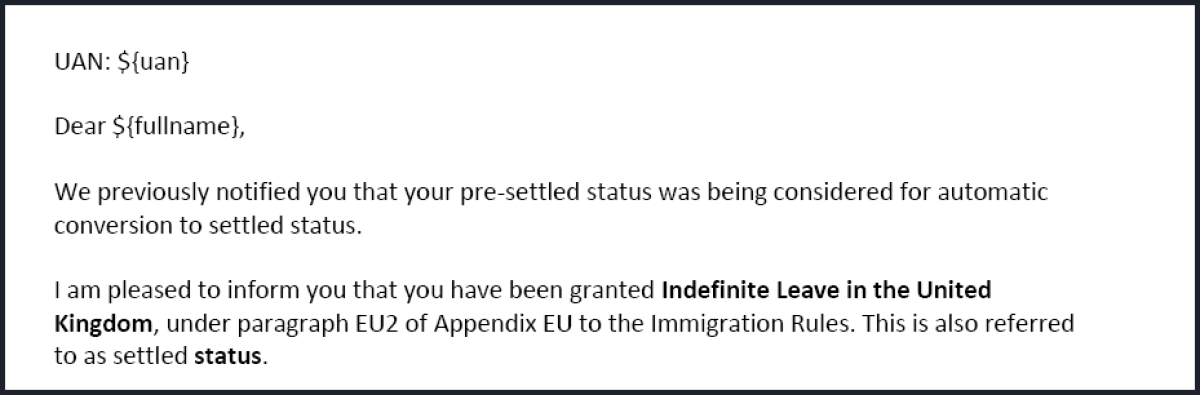
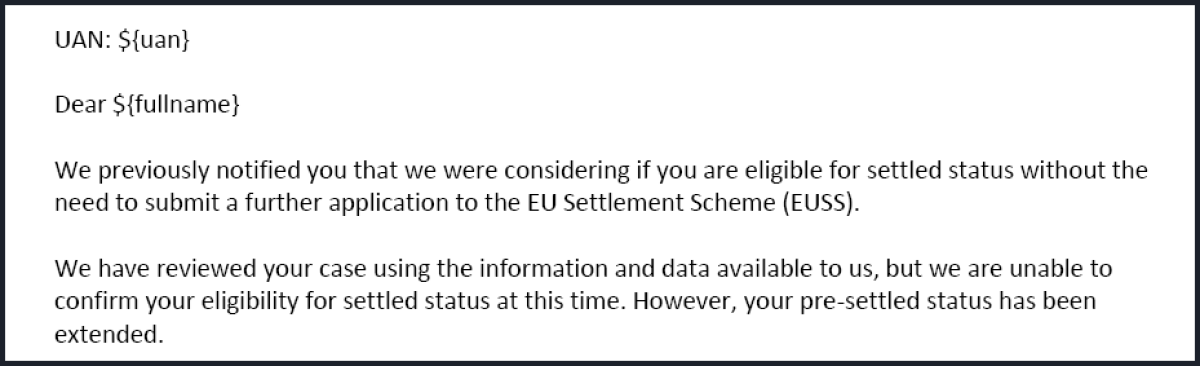
Shortly after receiving the initial email, you should receive one the following two emails:
- An email granting you settled status; OR
- An email granting you a five-year extension of your pre-settled status
Click on the images for the full email template (*).
- SETTLED STATUS GRANTED
If you were granted settled status in the previous step, this is the end of the automation process for you as you have been granted permanent settled status, and you shouldn’t get any further emails from the Home Office.
- PRE-SETTLED STATUS EXTENSION - what happens next?
If you are not an EU/EEA or Swiss citizen, or if you are under the age of 18, or if you only arrived in the UK after 31 December 2020, or if your pre-settled status is under other eligibility criteria (e.g. ‘derivative rights’):
- You should have been granted pre-settled status in the previous step, and this is also the end of the Automation process for you. Note however, if the Home Office removes your sponsor’s pre-settled status then they will likely examine your pre-settled status at some point in the future too.
In all other cases:
You will have been granted a five-year pre-settled status extension and now your case will continue to progress through the next stage of the automation process. Note, this only applies to you if you are an EU/EEA/Swiss citizen who is over the age of 18 and you were in the UK by 31 December 2020.
First, your pre-settled status, along with all other pre-settled statuses expiring around the same time as yours, will be compared against Home Office travel data (e.g. entry and exit records). All these pre-settled statuses will then be ordered in a list, from those with the lowest number of days absent from the UK to those with the highest number of days absent.
Next, Home Office caseworkers will look at the statuses at both extremes of the list, and decide what to do next.
There are with three possible outcomes for the next stage:
- OPTION 1: Receive an upgrade to settled status (for those with the fewest absences); OR
- OPTION 2: Enter the ‘minded to curtail’ process (for those with the longest absences); OR
- OPTION 3: Hear nothing further (for those in the middle)
Each of these stages is set out in more detail in the steps further down.
- PSS Extension OPTION 1 - Receive an upgrade to settled status based on travel data
Although in the initial automation stage, the Home Office was unable to automatically upgrade your pre-settled status to settled status, because they were unable to find evidence of 30 months of residence in the last 60 months just by looking at HMRC or DWP data, it is still possibly to be automatically upgraded based on the travel data.
Therefore, after the Home Office has looked at the travel data they hold for you, if they consider that you have been in the UK for at least 30 months out of the last 60, they will grant you settled status, and you will receive the email below.
If this situation applies to you, you might be a bit confused by the emails you’ve received over a short space of time, because by now you will have received:
- An email saying the Home Office will consider if you are eligible for settled status.
- An email saying they reviewed the information and data available to them but they were unable to confirm your eligibility for settled status, so they extended your pre-settled status instead.
- Now an email saying that you have been granted settled status.
This is because the Home Office could not grant you settled status on the basis of HMRC and DWP data, but they could grant you settled status after a caseworker reviewed your travel data. This is therefore a semi-automated grant of settled status.
Having been granted settled status, this is now the end of the automation process for you.
Click on the image for the full email template (*).
- PSS Extension OPTION 2 - Enter the ‘minded-to-curtail’ process
Once the Home Office has looked at both your HMRC and DWP data, and your travel data, if they think you have been out of the UK for too long, they can decide that they want to curtail or cancel your pre-settled status.
This process has a few stages, which we describe in the Curtailment/Cancellation Process section further down on this webpage.
- PSS Extension OPTION 3 - Hear nothing further
As explained earlier, your pre-settled status, along with all other pre-settled statuses expiring around the same time as yours, will be compared against Home Office travel data. All these pre-settled statuses will then be ordered in a list, from those with the lowest number of days absent from the UK to those with the highest number of days absent.
Home Office caseworkers will look at the statuses at both extremes of the list to decide which cases fall under Option 1 and Option 2 (meaning that a caseworker could either grant you settled status, or send you a 'minded-to-curtail' letter). Cases that are in the middle of the list in terms of the number of days absent from the UK, are unilkely to be considered under Option 1 or Option 2. Therefore, after about six weeks the Home Office will remove you from the automation process.
It means that if you have not heard anything within six weeks of receiving your five-year pre-settled status extension, you can assume that nothing further will happen (until your pre-settled status once again reaches its new expiry date).
You can make an application for settled status once you become eligible for it. See our downloadable 30/60 absence calculator to help you work out when this might be the case for you.
Details of the 'minded-to-curtail' process
- CURTAILMENT/CANCELLATION - Minded to curtail letter and requests for evidence
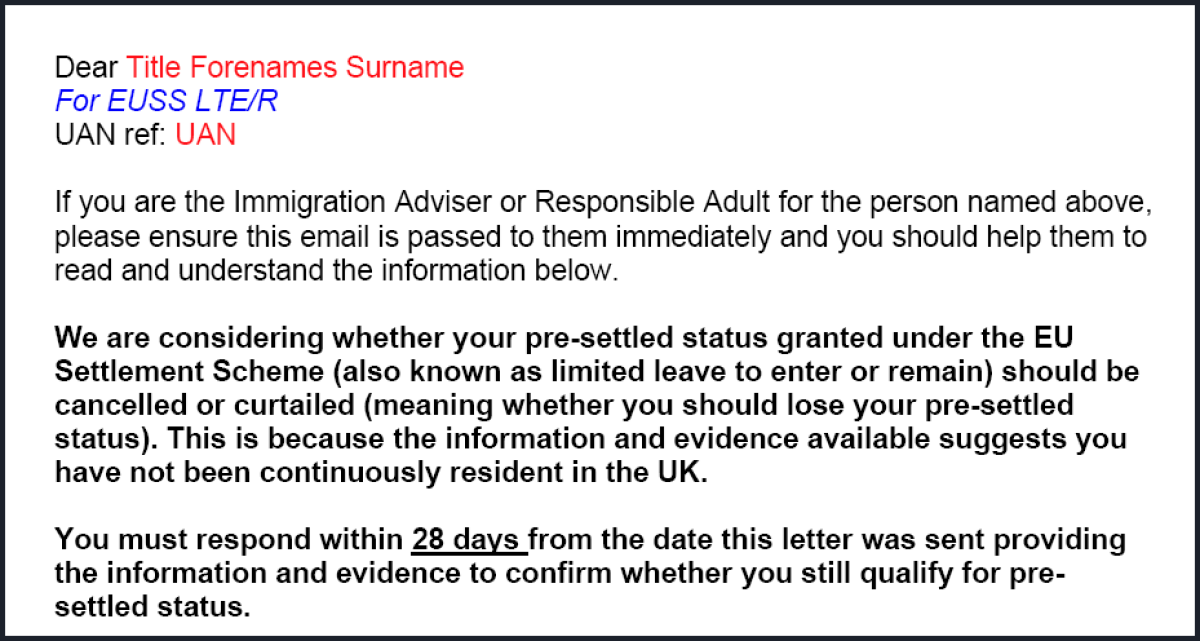
The first stage of this process is to send you a ‘minded to curtail’ letter as shown below.
If you receive this email, you will be asked to provide information and evidence to the Home Office within 28 days to show either:
- That you meet the continuous residence conditions or, if you do not meet these conditions;
- Reasons why it would be disproportionate to remove your pre-settled status.
You can request more time to respond from the Home Office Resolution Centre, and you might want to seek legal advice. See Home Office caseworker guidance "EU Settlement Scheme: cancellation and curtailment" for more information about proportionality.
Click on the image for the full email template (*).
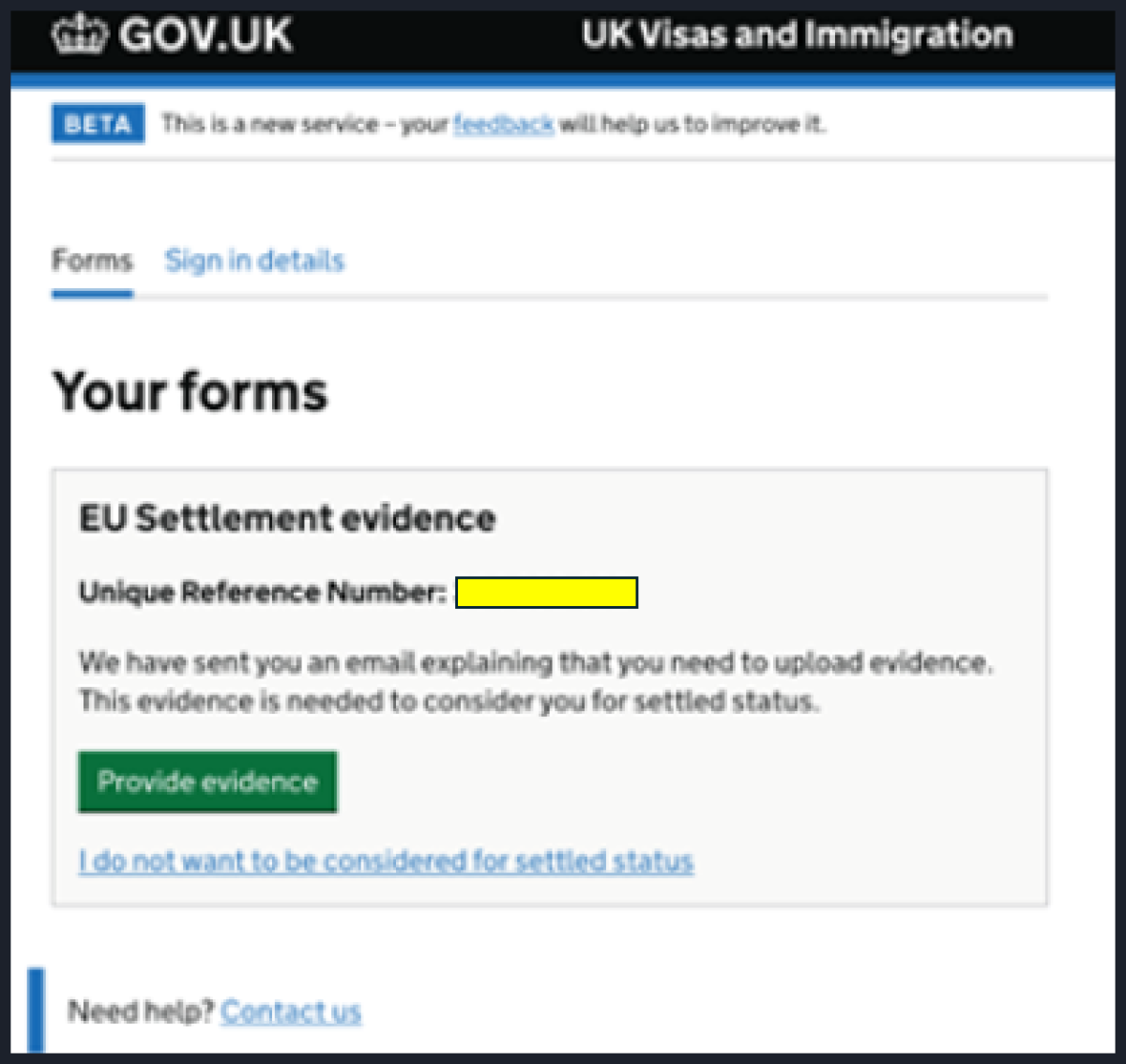
To provide evidence, the letter gives instructions to login to your UKVI dashboard (at https://apply-to-visit-or-stay-in-the-uk.homeoffice.gov.uk/dashboard"). We are told that when you do so, there should be an entry on the dashboard with the Unique Application Number (UAN) provided in the minded-to-curtail letter. See below for a picture of what you should see when you login to your dashboard.
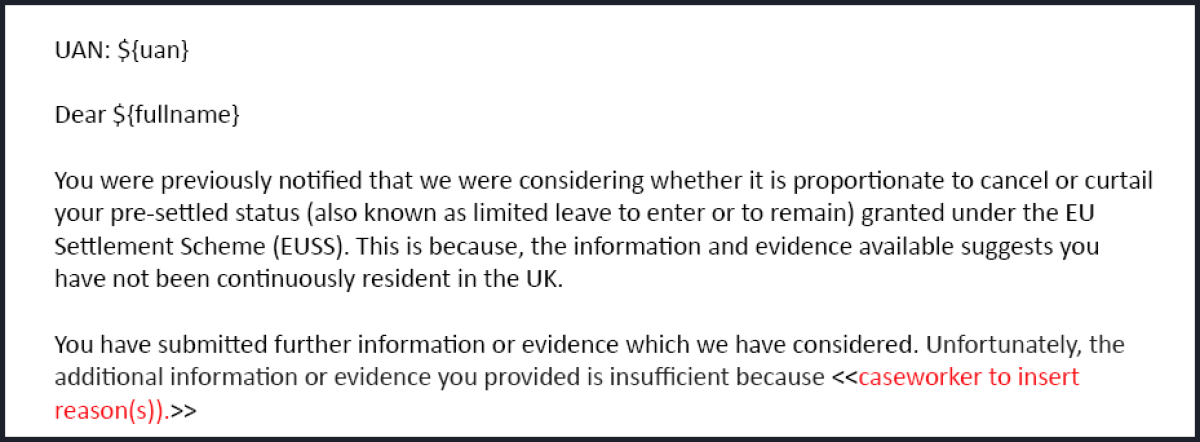
If you have provided information and evidence to the Home Office but they want more evidence, then the Home Office will send you the email below, requesting further evidence.
Click on the image for the full email template (*).
- CURTAILMENT/CANCELLATION - What happens next?
At this point, there are four possible outcomes depending on the evidence and information you provide to the Home Office:
- OPTION 1: You are granted settled status.
- OPTION 2: You are not eligible for settled status, but it would be disproportionate to remove your pre-settled status, so you can keep your pre-settled status.
- OPTION 3: Neither option 1 or 2 applies, and the Home Office issues a curtailment decision.
- OPTION 4: Neither option 1 or 2 applies, and the Home Office issues a cancellation decision.
Each of these is explained further below.
- CURTAILMENT/CANCELLATION - OPTION 1: Granted settled status
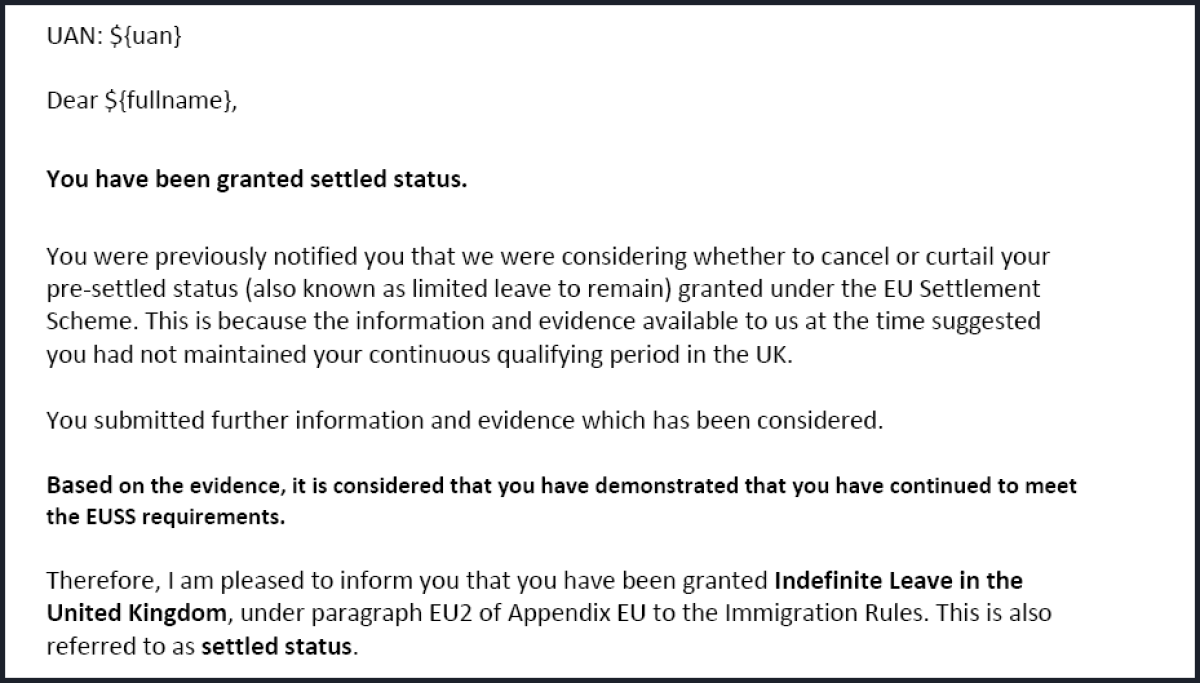
If, having looked at your evidence, the Home Office decides that you are in fact eligible for settled status having completed a five-year continous residence period, then they will send you the email below granting you settled status.
Click on the image for the full email template (*).
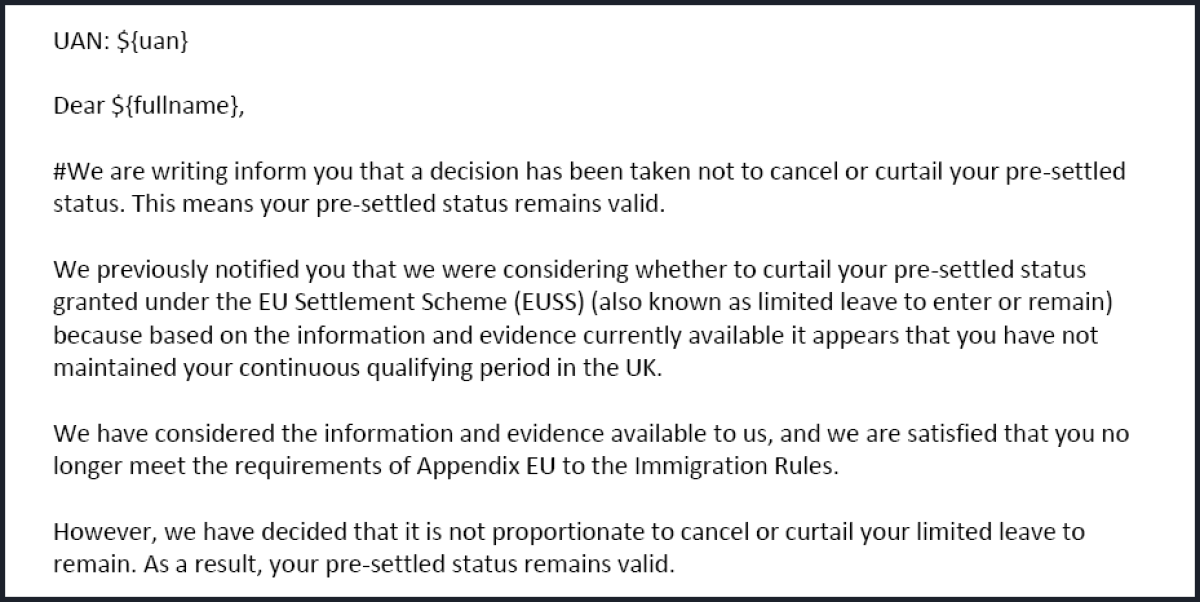
- CURTAILMENT/CANCELLATION - OPTION 2: Pre-settled status maintained
If, having looked at your evidence, the Home Office decides that even though you are not currently eligible for settled status, it would not be proportionate for you to lose your pre-settled status, then they will send you the email below telling you that you can keep your pre-settled status.
The email also explains that if you build up your UK residence, you may become eligible for settled status in future, and that you can submit an application for it as soon as you do. See our downloadable 30/60 absence calculator to help you work out when this might be the case for you.
Click on the image for the full email template (*).
- CURTAILMENT/CANCELLATION - OPTION 3: Curtailment decision
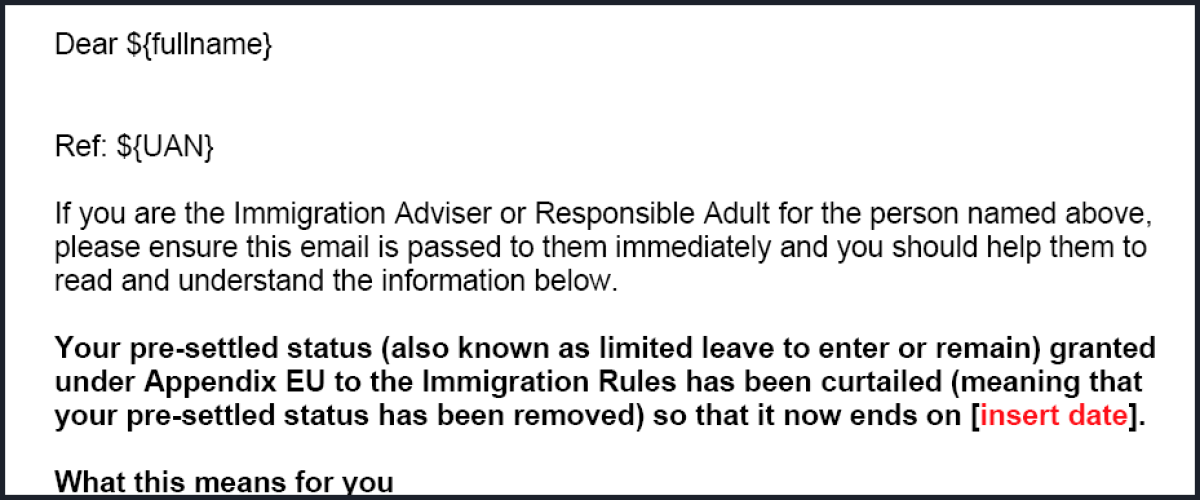
If the Home Office decides that you are not eligible for settled status, and that it would not be disproportionate to remove your pre-settled status, then they will send you either a curtailment or a cancellation decision.
A curtailment decision (see below) is sent when the Home Office thinks you are currently in the UK. You can appeal this decision within 14 days of the curtailment decision letter. If you do submit your appeal within 14 days, you will keep your pre-settled status until your appeal receives a final decision.
Click on the image for the full email template (*).
- CURTAILMENT/CANCELLATION - OPTION 4: Cancellation decision
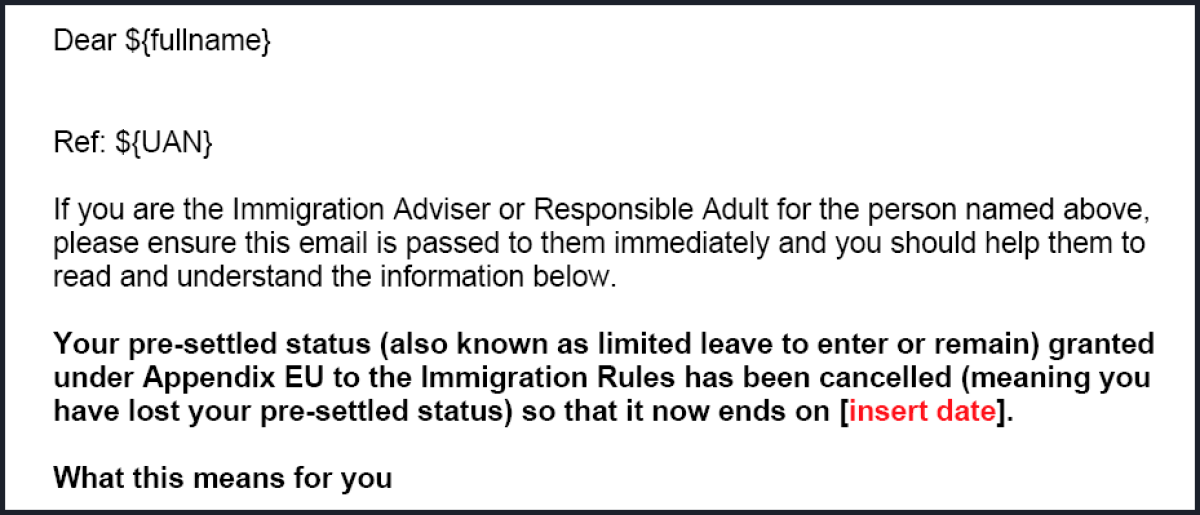
If the Home Office decides that you are not eligible for settled status, and that it would not be disproportionate to remove your pre-settled status, then they will send you either a curtailment or a cancellation decision.
A cancellation decision (see below) is sent when the Home Office thinks you are currently outside the UK. Your pre-settled status is lost with immediate effect. You can appeal this decision within 28 days of the cancellation decision letter. Your pre-settled status will be re-instated if you eventually win your appeal. If you want to travel to the UK in the meantime, you will need to apply for permission to enter on another legal basis.
Click on the image for the full email template (*).
Other information and useful resources:
- Home Office: EU Settlement Scheme (EUSS) status automation update: April 2026
- Home Office: EU Settlement Scheme: UK tax and benefits records automated check
- Home Office: Letter to House of Lords European Affairs Committee regarding the automation update: April 2026
- Home Office: EU Settlement Scheme: cancellation and curtailment guidance - includes guidance on proportionality assessments
- the3million: Automatic upgrades to settled status
- the3million: Changes to the absence policy for pre-settled status holders under the EU Settlement Scheme
- the3million: Absence calculator
- the3million’s correspondence with the Home Office about Phase 3 Automation:
- EU Citizens UK: Moving from pre-settled to settled status - Automation
- EU Citizens UK: Can I lose my pre-settled status if I am away from the UK for too long?
- EU Citizens UK: Flow chart of Phase 3 Automation
- FreeMovement: Continuous residence under the EU Settlement Scheme: changes to automated settlement process and expanded cancellation policy


